
Author: Hadiya Zainab
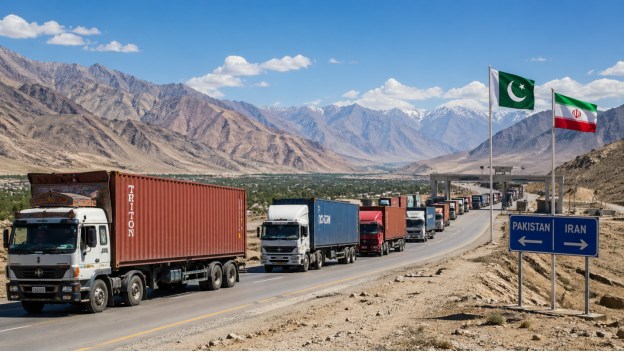
Islamabad, April 30, 2027 (GGPI): Pakistan has opened overland trade corridors into Iran to facilitate the movement of goods. This decision was taken keeping in view the recent blockade of Strait of Hormuz, affecting a significant amount of cargo leaving some stranded in the Port of Karachi, Pakistan. According to Pakistani officials, the trade corridors will assist both domestic and third-country goods to transit from Pakistan to Iran effectively bypassing the disrupted sea passage.
“We have operationalized several designated corridors to ensure that trade flows remain uninterrupted under the current circumstances,” a senior commerce ministry official said, adding that the framework includes regulatory mechanisms to manage transit trade efficiently. The official noted that the move was taken “in view of the extraordinary situation in regional waters” and to address mounting logistical bottlenecks.
Read More: Trump is Betting His Blockade will Defy History and Break Iran
Official further stated coordination with Iranian authorities is going to streamline economic and political activity despite the blockade of US on Iranian ships. Politically speaking, this move also indirectly weakens the blockade of US at the Strait of Hormuz by ensuring that some trade still continues, highlighting how states adapt to regional sea crises by rerouting and taking an alternative through land trade.
Officials further stated that coordination with Iranian authorities is ongoing to streamline customs procedures and ensure timely clearance of goods at border crossings. “This arrangement is temporary but necessary to sustain economic activity and minimize supply chain disruptions,” another official said, emphasizing that Pakistan is acting to facilitate trade rather than alter its broader policy posture.
This shows Pakistan’s significance as a transit intermediary during these difficult times. Experts say, even though this solution is only temporary it could improve Pakistan’s position as it improves regional connection and helping countries’ economies remain stable.
Note: The image is AI generated and only for reference.
About the Author:
Hadiya Zainab is a BS International Relations student at the National University of Modern Languages (NUML), Rawalpindi, and a Research Fellow at Global Geopolitical Insight. Her research interests focus on defense studies, regional security, and contemporary geopolitical dynamics, with a particular emphasis on Asia.