
Author: Menahil Hasna Awan
BERLIN/VIENNA, April 30, 2026 (GGPI) — A significant increase in Russian military-affiliated cargo flights to Algeria over the past year highlights the North African nation’s growing role as a strategic logistics hub for Moscow’s expanding influence across Africa, according to a recent investigation.
Data indicates that at least 167 cargo flights connected Russia and Algeria between March 2025 and April 2026. These flights frequently linked Russian airfields associated with major aircraft production facilities to multiple Algerian air bases, suggesting ongoing deliveries of advanced military equipment, including next-generation fighter aircraft.
Algeria, a longstanding defense partner of Russia, is reportedly receiving modern platforms such as Su-57 stealth fighters and Su-35 aircraft, while continuing to operate existing fleets of Su-30 and MiG-29 jets. The timing of cargo flights has coincided with sightings of newly deployed Russian-made aircraft in Algerian airspace, reinforcing assessments that these operations support military modernization efforts.
Read More: Russia–Ukraine Conflict Intensifies as NATO Signals Heightened Readiness Eastern Europe
Analysts suggest that Algeria is not only a recipient of military hardware but also a transit hub for Russian logistical operations deeper into Africa. Flight tracking patterns indicate routes extending from Algeria to countries such as Guinea and potentially Niger, regions where Russian economic and security interests have expanded in recent years.
The investigation further highlights the role of so-called “shadow airlines”—civilian-registered cargo carriers operating under complex ownership and leasing structures. These operators reportedly facilitate the transport of military equipment, personnel, and other sensitive cargo while maintaining plausible deniability and bypassing international restrictions.
Aircraft frequently utilized in these operations include the Ilyushin Il-76 and Antonov An-124, both capable of transporting heavy military cargo over long distances. Due to range limitations and restricted access to global airspace, Algeria’s geographic position has made it a critical refueling and staging point for Russian logistics networks.
Experts note that some flights employ tracking evasion techniques, such as disabling transponders or misreporting routes, further complicating efforts to monitor these activities. Additionally, links between these cargo operations and Russian paramilitary logistics networks in Africa have been identified, suggesting a broader strategic framework that integrates military, economic, and security objectives.
Despite Western sanctions affecting Russia’s defense export sector, Algeria remains one of Moscow’s most important arms clients. The country historically sourced a majority of its military equipment from Russia and continues to engage in significant procurement agreements.
Industry observers emphasize that the expansion of these logistics networks reflects Russia’s adaptation to sanctions and its ongoing efforts to sustain global influence through alternative supply chains and partnerships.
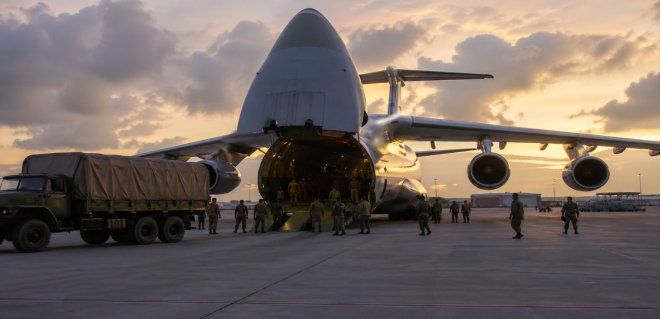
Note : This image is AI generated for References.
About the Author:
Menahil Hasna Awan is a Geopolitical Analyst and BS International Relations Student at National University of Modern Languages , Rawalpindi, She is also a Research Fellow at Global Geopolitical Insight, Research focus : Defence Studies