
Author: Malahat Hashmi
Historical Background of Arab–Israel Relations
The relationship between Arab states and Israel has historically been defined by conflict, hostility, and deep political mistrust. The roots of this divide go back to the creation of Israel in 1948, which led to the first Arab-Israeli war and the displacement of a large number of Palestinians. Over the decades, several wars were fought between Israel and neighboring Arab states, including Egypt, Jordan, and Syria.
Despite prolonged hostility, some diplomatic breakthroughs occurred. Egypt became the first Arab country to recognize Israel through the 1979 Camp David Accords, followed by Jordan in 1994. However, most Arab states continued to condition normalization with Israel on the resolution of the Palestinian issue, particularly the establishment of an independent Palestinian state.
This stance was formally reflected in the Arab Peace Initiative of 2002, which offered normalization with Israel in exchange for full withdrawal from occupied territories and a fair settlement of the Palestinian question. For years, this remained the dominant regional framework guiding Arab-Israeli relations.
Emergence of the Abraham Accords
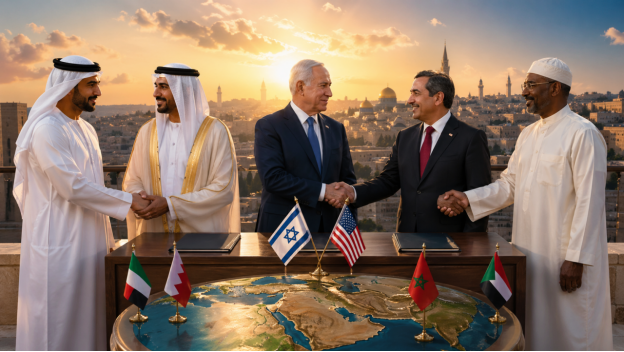
A major shift occurred in 2020 with the signing of the Abraham Accords, a series of normalization agreements between Israel and several Arab countries. The first agreements were signed by the United Arab Emirates and Bahrain, followed later by Sudan and Morocco. These agreements were brokered by the United States and marked a departure from the long-standing Arab consensus that prioritized Palestine before normalization.
The Accords established formal diplomatic relations, opening embassies, direct flights, and cooperation in areas such as trade, tourism, technology, and security. The agreements were presented as a step toward peace and regional stability, aiming to foster economic growth and reduce tensions in the Middle East.
Unlike earlier peace treaties, which followed direct conflict, the Abraham Accords were largely driven by shared strategic interests rather than war termination. This made them fundamentally different in both motivation and structure.
A Shift from Ideology to Strategic Interests
One of the most important aspects of the Abraham Accords is the shift from ideological commitments to pragmatic, interest-based diplomacy. Traditionally, Arab states placed strong emphasis on pan-Arab solidarity and the Palestinian cause. However, changing regional dynamics have altered these priorities.
Several Gulf states increasingly view Iran as a major regional threat due to its nuclear ambitions and influence in countries like Yemen, Syria, and Iraq. In this context, Israel is seen as a valuable security partner with advanced military and intelligence capabilities. This convergence of interests has played a key role in bringing these states closer together.
Economic diversification is another critical factor. Countries like the UAE are focusing on reducing dependence on oil and expanding into sectors such as technology, tourism, and innovation. Israel, being a global leader in technology and startups, offers significant opportunities for cooperation.
Read More: Mexico, Japan Agree on Energy Cooperation as Iran War Disrupts Supplies
Thus, the Accords reflect a broader transformation in Middle Eastern geopolitics, where national interests and security concerns are increasingly shaping foreign policy decisions.
Impact on the Palestinian Issue
One of the most debated aspects of the Abraham Accords is their impact on the Palestinian cause. Critics argue that these agreements have weakened the collective Arab position and reduced pressure on Israel to negotiate a two-state solution.
Palestinian leadership strongly opposed the Accords, viewing them as a betrayal of long-standing commitments. They argue that normalization without addressing Palestinian rights undermines the prospects for an independent state and allows the status quo to continue.
Supporters of the Accords, however, claim that engagement with Israel could eventually create opportunities for dialogue and peace. They argue that isolating Israel has not resolved the conflict, and new approaches are needed to break the deadlock.
Despite these arguments, the reality remains that the Palestinian issue has become less central in regional diplomacy compared to previous decades, highlighting a significant shift in priorities.
Regional and Global Implications
The Abraham Accords have wide-ranging implications for both regional and global politics. Regionally, they have contributed to the formation of new alliances, particularly among states that share concerns about Iran. This has led to increased security cooperation and intelligence sharing.
The agreements have also encouraged economic integration, with growing trade, investment, and technological partnerships between Israel and participating Arab states. This has the potential to reshape regional economies and create new opportunities for development.
Globally, the Accords reflect the role of external powers, especially the United States, in facilitating diplomatic agreements in the Middle East. They also signal a broader shift toward multipolarity, where regional actors are increasingly making independent strategic decisions rather than strictly following traditional alliances.
However, the agreements also carry risks. The exclusion of key regional players and unresolved conflicts may limit their long-term effectiveness and could lead to new tensions if underlying issues remain unaddressed.
Conclusion
The Abraham Accords represent a significant turning point in Middle Eastern diplomacy, marking a move away from traditional conflict-driven relations toward pragmatic cooperation based on shared interests. While they have opened new avenues for economic growth, security collaboration, and diplomatic engagement, they have also raised important questions about the future of the Palestinian issue and the sustainability of regional peace.
Rather than a complete resolution of conflict, the Accords appear to be a strategic realignment reflecting changing geopolitical realities. They highlight how states are prioritizing national interests, security concerns, and economic opportunities over ideological commitments.
In this sense, the Abraham Accords are both a sign of progress and a source of uncertainty. The key question moving forward is whether this new framework can evolve into a more inclusive and lasting peace, or whether it will deepen existing divisions by sidelining unresolved conflicts at the heart of the region.
Note: The image is AI generated and for reference
About the Author:
Malahat Hashmi is a BS International Relations student at the National University of Modern Languages (NUML), Rawalpindi, and a Research Fellow at Global Geopolitical Insight. Her research interests focus on regional security, Middle Eastern geopolitics, and contemporary international relations, with a particular emphasis on strategic realignments and emerging diplomatic trends.