
Author: Amna Masood
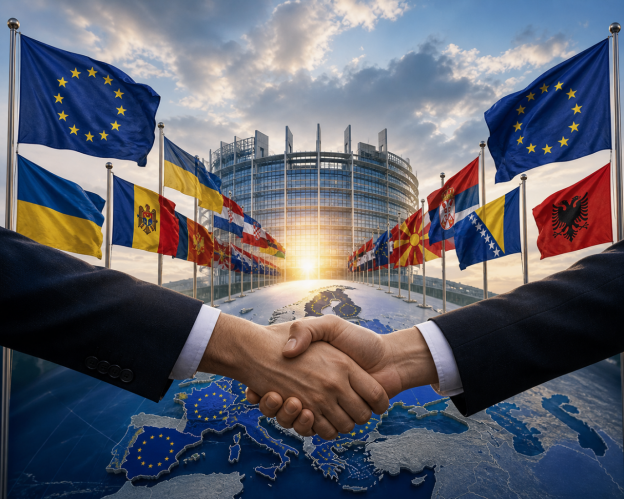
Brussels, May 5, 2026 (GGPI): The European Union has stepped up its expansion dialogue, marking a renewed strategic push to integrate candidate states amid shifting geopolitical realities. Enlargement, once treated as a gradual and technical process, is now increasingly viewed through a security and political lens as Europe adapts to a more volatile regional environment.
At the forefront of current discussions are Ukraine, Moldova, and the Western Balkan states, all positioned at different stages of accession. The prolonged Russia–Ukraine conflict has significantly altered the urgency surrounding their inclusion. European leaders now perceive enlargement as a tool to reinforce regional stability, limit external influence, and strengthen the Union’s geopolitical coherence. In this context, expansion is no longer merely about institutional growth but about safeguarding Europe’s strategic interests.
From Brussels’ standpoint, enlargement serves to extend democratic norms, enhance economic integration, and create a buffer against instability along its borders. However, the accession process remains conditional and demanding. Candidate countries are required to demonstrate progress in governance reforms, rule of law, anti-corruption measures, and economic alignment with EU standards. While some states have made notable advancements, others continue to face structural challenges that complicate their path toward membership.
Read More: The United States in a Shifting Global Order: Maintaining Hegemony Amid Rising Multipolarity
Internally, the expansion agenda has exposed divisions within the EU. Several member states, particularly in Eastern Europe, advocate for a faster and more flexible accession process, emphasizing the geopolitical necessity of enlargement. In contrast, others stress caution, pointing to concerns over institutional capacity, budgetary pressures, and decision-making efficiency within an already complex Union. These differing perspectives highlight the delicate balance between strategic urgency and institutional readiness.
Economically, expansion presents both promise and strain. The integration of new markets offers potential gains in trade, investment, and labor mobility, potentially revitalizing parts of the European economy. At the same time, disparities in development levels between existing and candidate members could place additional pressure on cohesion funds and fiscal frameworks. Managing these disparities will be crucial to maintaining unity within the bloc.
From a broader perspective, EU expansion reflects an evolving global order where regional blocs are consolidating power in response to intensifying competition. By advancing enlargement, the EU seeks to solidify its role as a central geopolitical actor while reinforcing its foundational principles of cooperation and stability.
Although accession timelines remain uncertain, the current momentum suggests that enlargement has re-emerged as a defining priority for the Union. The success of this process will depend on the EU’s ability to reconcile internal differences while guiding candidate countries through a demanding but transformative path toward integration.
Note: Image is AI generated for reference
About the Author:
Amna Masood is a Geopolitical Analyst and BS International Relations Student at National University of Modern Languages, Rawalpindi, Research Focus: Geopolitics of Europe