
Author: Hadiya Zainab
Introduction
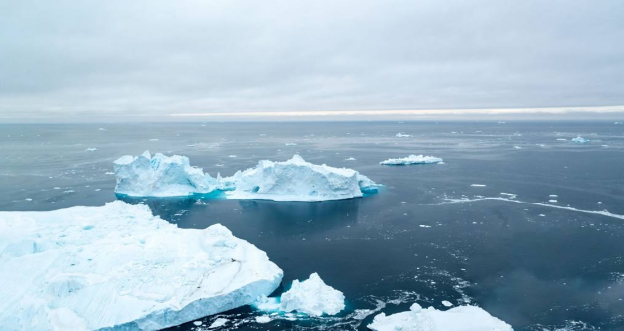
The Arctic Ocean is the smallest, shallowest, and coldest of the world’s oceans. It covers approximately 5.1 to 6.4 million square miles around the North Pole. It is enclosed by Europe, Asia, North America and Greenland. For decades, Arctic Ocean’s utilization has rather remained limited due to the layer and cover of ice all year. But, the narrative has taken a turn, due to climate change, the melting waters seems to provide a strategic checkpoint for positioning and for economics globally.
Climate Change as a Global Geopolitical Driver
The Arctic Council reported that the Arctic continues to rise the three times compared to global annual average, driving many of changes underway the Arctic. This impacts both local ecosystems but also global climate system. It contributes to rising sea levels and provokes extreme temperature levels.
This rapid change in climate is slowly becoming a geopolitical driver. It is giving opportunities to making Arctic one of the major, prominent trademark and checkpoint for trade and social implications and furthermore, the accessibility to the Arctic has increased. To wrap it up, Climate change has literally changed the political geography of the world.
Shipping Routes and the Reordering of Global Trade
Northern Sea Route is the water passage that runs from the northernmost parts of the Northern Sea across the icy waters of the Arctic Ocean, north of Russia. Along with that is the Northeast Sea passage that makes the distance between Europe and Asia 3 times shorter or 40% less than the Suez Canal. But the limitation is that the Northeast Sea passage has restricted use due to its extreme natural conditions. However, if the climate change continues to bring warmer air to the Arctic, this passage might prove to be more accessible and favorable for a trade sea route. And the climate change of the year 2026 and the upcoming year seems to do exactly that. What does this all indicate? Strategic leverage.
Read More: The United States in a Shifting Global Order: Maintaining Hegemony Amid Rising Multipolarity
In its 2018 Arctic policy white paper, China described itself as a “near-Arctic state.” Earlier, in 2013, China, Japan, India, Italy, the South Korea, and Singapore were granted observer status in the Arctic Council, joining existing observers such as France, Germany, Netherlands, Poland, Spain, Switzerland, and the United Kingdom. Moreover, in 2025, Trump threatened to take siege and full control of Greenland? Why is that? Strategic leverage over the Arctic seems to be a favorable answer.
The other question that remains is if Arctic becomes a fully functioning trade route, what affect does that have on older chokepoints like Suez Canal and Strait of Malacca? Yes, this does affect the Suez Canal and Strait of Malacca but not entirely in a negative manner. The Arctic Ocean cannot fully replace the checkpoints, what it could do is decrease its congested strategic centrality. However, the important nuance is this: Arctic routes are more likely to complement than replace traditional chokepoints. Seasonal navigability, insurance costs, limited infrastructure, ice-class vessel requirements, and political uncertainty still make the Arctic a niche route rather than the main artery of global trade.
Natural Resources and the Politics of Extraction
Then comes the natural resources of the Arctic region, which will be responsible increased competition and the exploitation of Arctic, if the climate change does not make the region fully accessible, the extraction of these sources will. The Arctic region contains exceptionally large reserves of rare-earth elements, including neodymium, praseodymium, terbium, and dysprosium, many of which are essential for the global transition to cleaner energy, furthermore metals such as gold, iron, lead, nickel, silver, and zinc, to industrial minerals like mica, to construction materials including sand, gravel, and crushed rock, to precious stones such as diamonds and rubies, and to energy resources such as oil, gas, and coal. metals such as gold, iron, lead, nickel, silver, and zinc, to industrial minerals like mica, to construction materials including sand, gravel, and crushed rock, to precious stones such as diamonds and rubies, and to energy resources such as oil, gas, and coal. In estimates, it makes up 30% of the undiscovered natural gas resources and 13% of the world’s undiscovered petroleum according to the U.S. Geological Survey estimates.
And that is exactly why the Arctic keeps the rich Russia, richer and also why Russia wants others to use, and pay to use the Northern Sea Routes. Most of these resources are under Russian federation and Alaska. Alaska holds substantial mineral wealth, including about 12% of the world’s coal, 3% of its zinc, 3.5% of its gold, 1.6% of its lead, 1.5% of its silver, and 0.3% of its copper. Despite the economic disruption caused by the COVID-19 pandemic, Alaska’s mineral industry was valued at roughly $3.2 billion in 2020, even as exploration spending fell by 15% and development spending declined by 23%.
These estimates is exactly why all Arctic regions want to assert authority over the region, in fact this competition over assertiveness has been nicknamed “The New Cold War” or simply the “Race for the Arctic”. In today’s date, and a worsened state of the Strait of Hormuz, the Arctic gives the regions a new trade route and new economic opportunities, and that creates an atmosphere of immense prizefight.
Great-Power Rivalry in the High North
The Arctic is increasingly important not only for trade and resources but also for military and naval presence enabled by climate change. IR scholars like Rebecca Strating and Elizabeth Mendenhall see oceans as arenas of strategic rivalry, while Heartland and Rimland theories emphasise that control of maritime routes is central to state power.
Speaking of strategic competition, Russia has markedly expanded its military presence in the Arctic by establishing a new Arctic command, reopening both new and former Soviet-era military installations, including airfields and deep-water ports, and conducting tests of advanced weapons systems. It has set out a long-term plan, that phases from 2020-2035, to open up the Arctic region by making a series of investments in infrastructure, energy and transport. The plan is aimed at expanding ports, constructing icebreakers powered by nuclear resources, and enhancing year-round shipment through the Northern Sea Route to boost the Arctic shipping capacity. Together with economic development, the strategy also boosts military preparedness by providing dual-use infrastructure and vessels which reflect the intention of the Russians to secure the Arctic as a hub of energy as well as a strategic maritime region.
At the same time, NATO presence in the Arctic has not gone unnoticed. It has conducted military exercises in the region since the days of Cold War. In recent years, NATO has stepped up the scale of these military exercises to make sure that its existence is not gone underestimated, especially by Russia. In 2019, NATO established Joint Force Command Norfolk (JFC Norfolk), the Alliance’s operational headquarters in North America (in Norfolk, Virginia, United States). One of its main duties is to secure the strategic sea lines of communication across the Atlantic. In February 2026, launched “Arctic Sentry” which further strengthens its deterrence and significance in the Arctic.
Due to this, rivalry of the NATO alliances and Russia, China has shown significant importance. China and Russia have a long and complex relationship marked by both cooperation and rivalry. Historically, relations evolved from early limited contact to periods of territorial conflict and unequal treaties, followed by ideological tensions during the Sino-Soviet split in the Cold War. Since the early 2000s, however, ties have significantly improved after border disputes were resolved and cooperation agreements were signed, including the 2001 Treaty of Good-Neighbourliness.
In recent years, the partnership has strengthened further, especially after Russia’s 2014 annexation of Crimea and the 2022 war in Ukraine, which pushed both countries closer due to shared tensions with the West. They declared a “no limits” partnership and expanded cooperation in trade, energy, and security. In the Arctic, this includes joint investment in resource projects, collaboration on the Northern Sea Route, and increasing military coordination.
However, analysts note that the relationship is pragmatic rather than fully equal, with Russia becoming more dependent on China due to sanctions and the Ukraine conflict.
Why the Arctic is important for Asia? Why the Arctic is important for Asia?
The Arctic is increasingly significant for Asia because it is becoming embedded in broader patterns of economic interdependence and strategic competition that shape state behavior in a realist sense. For major East Asian powers such as China, Japan, and South Korea, emerging Arctic shipping routes offer potential reductions in transport time to Europe, raising their relevance for trade security and supply chain resilience. More importantly, Asian engagement reflects not cooperation for its own sake, but strategic positioning in anticipation of shifting global material conditions. China illustrates this clearly: its Arctic presence has evolved from scientific participation, through expeditions using Xue Long, the establishment of the Yellow River Station in 2004, and observer status in the Arctic Council in 2013, into a broader strategy linking research, governance participation, and long-term economic interests in shipping and resources. However, this is not an exclusively Chinese phenomenon. Japan and South Korea also pursue Arctic engagement through scientific research, energy security considerations, and maritime strategy, reflecting how multiple Asian states are responding to structural changes in the global distribution of resources and routes. From a realist perspective, the Arctic matters for Asia not because it is geographically central, but because it is becoming a space where shifts in access, capability, and connectivity may translate into future strategic advantage within an evolving global balance of power.
Conclusion
The Arctic’s transformation demonstrates how climate change has become inseparable from global geopolitics. Environmental change is reshaping the strategic value of geography by enabling new trade routes, unlocking resource potential, and intensifying state competition. Consequently, the Arctic is shifting from a peripheral, low-tension space into one increasingly embedded in global power politics. The region therefore reflects a growing tension between expanding strategic interests and fragile institutional frameworks. Ultimately, the Arctic matters because it reveals climate change as a structural force reshaping the distribution of power in international relations.
Note: The image is taken from open sources.
About the Author:
Hadiya Zainab is a BS International Relations student at the National University of Modern Languages (NUML), Rawalpindi, and a Research Fellow at Global Geopolitical Insight. Her research interests focus on defence studies, regional security, and contemporary geopolitical dynamics, with a particular emphasis on Asia.