
Author: Qadeer Abro
Introduction
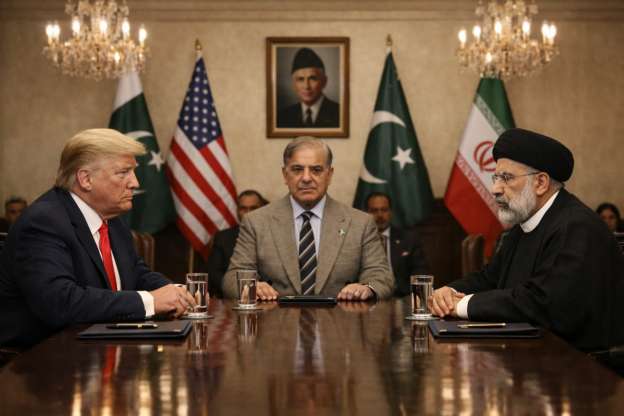
The United States and Israel launched strikes against Iran on February 28, 2026, targeting Iran’s military installations, energy facilities, and leadership. Trump named this operation “Operation Epic Fury”. Ayotullah Khomneni, Iran’s supreme leader was assassinated as a result of this operation. Iran launched “Operation True Promise” in retaliation for these strikes, attacking Israeli and American military and naval installations throughout the Middle East, especially in the Gulf Cooperation Council. Iran’s attacks on the Gulf States and the GCC, as well as its blockade of the Strait of Hormuz, were just a few of the regional ramifications of this war that soon extended beyond Iran and the United States. The conflict took on a regional character as a result. Pakistan made significant diplomatic efforts and used backdoor diplomacy to facilitate the announcement of a ceasefire between the United States and Iran on April 8, 2026. Since Pakistan is also impacted by this conflict, it has been acting as a mediator. Pakistan’s neighbor is Iran, and Islamabad maintains close relations with the GCC, particularly Saudi Arabia. Approximately 80–85% of Pakistan’s gas and oil are imported via the Strait of Hormuz. Oil supplies have now been disrupted and oil prices have been rising in Pakistan as a result of the Strait of Hormuz blockade. Pakistan has maintained a balanced approach to this conflict thus far, emphasizing diplomatic engagement and communication from the outset.
Pakistan’s Strategic Motivations, Interests And Compulsions In Mediating Between Usa And Iran
Strategic Alignment With Saudi Arabia
The longer the conflict continues and Iran attacks Saudi Arabia, the more pressure will come on Pakistan from Saudi Arabia to defend the Kingdom, because in 2025 Pakistan and Saudi Arabia signed “The Strategic Mutual Defence Agreement (SMDA)” and according to this pact, an attack against any one country shall be considered an attack or aggression against both. Both states will then respond to those attacks together. If this defence pact were activated, Pakistan would have to defend Saudi Arabia as well and also carry out attacks on Iran. The outcome of this would have been that Iran would then also launch missiles and drone strikes on Pakistan.
Volatile Relations With Three Neighboring States
Pakistan launched open war on Afghanistan following the Islamabad Mosque Blast in February 2026, and “Operation Gazab Lil-Haq” is currently in action against the TTP and its Afghan handlers. Pakistan has also recently attacked Kabul, Kandhar, and Jalalabad with airstrikes. In other words, Pakistan and Afghanistan are already at war. Therefore, it would have been disastrous for Pakistan’s security to open another front with Iran. In other words, Pakistan would have been at war with Afghanistan and Iran, two of its Western neighbors. India suspended the Indus Water Treaty following the Pahalgam incident, and the two states engaged in a four-day conflict in May 2025. By utilizing the Indus Water Treaty as a political weapon against Islamabad, India has turned water into a weapon against Pakistan. Additionally, India finances and supports the TTP and BLA, two terrorist groups that have been conducting cross-border attacks in Pakistan. Examples of this include the Jaffar Express hijacking and the blast at the Islamabad mosque. So, in this scenario, if Pakistan were to provide military support to Saudi Arabia and the GCC States, Pakistan would end up in war-like situation with all of its neighbors.
Read More: CNS Sichuan Deployment Highlights China’s Growing Naval Power in the South China Sea
Protection Of Economic Interests
Pakistan imports nearly 80–85% of its oil and gas needs from the Gulf States via the Strait of Hormuz, making it dependent on the GCC or Gulf States for its energy needs. Pakistan is currently mediating to safeguard its own economic interests. Pakistan’s economic interests dictate that its supply chains and oil shipments should not be adversely affected by this conflict. Pakistan already faces economic crisis, political polarization, and problems with governance. Therefore, if oil supplies are cut off, the Pakistani government would have to raise oil prices even more, which would cause inflation to skyrocket in Pakistan.
To Prevent Sectarian Divide And Public Backlash
Apart from strategic motives and economic interests, Pakistan also had to prevent sectarian divide and public backlash. The Pakistani public has always believed in Muslim brotherhood. Whenever there is an attack on any Muslim country, like Gaza, the sentiments of Pakistani public are hurt. There is undoubtedly a Shia-Sunni divide in Pakistan, but when Ayotullah Khomenei passed away, the entire Pakistani population denounced Israel and the United States. Moreover, ten protesters were killed in an attack on the US Embassy in Karachi. In the Gilgit-Baltistan region, there was another violent protest that resulted in the deaths of both protesters and security personnel. Therefore, if Pakistan had been forced to join this war due to the activation of the Saudi-Pakistan Defense Pact, the Pakistani people would have turned against their own country and claimed that Pakistan was supporting Israel and the United States against its Muslim brothers. Pakistan saw this similar situation after 9/11 when it joined the USA’s Global War on Terror, when the Pakistani public turned against the Musharraf regime after the regime joined the US War on Terror.
Read More: Mexico, Japan Agree on Energy Cooperation as Iran War Disrupts Supplies
To Boost Soft Power And Diplomatic Outreach
Pakistan’s diplomatic influence has increased even though the Islamabad Peace Talks concluded without a deal between the United States and Iran. For instance, President Trump publicly commended the Field Marshal and Prime Minister of Pakistan. Many European nations are contacting Pakistan to express gratitude; Pakistan is generating headlines globally, which has boosted Pakistan’s soft power diplomacy that Islamabad is a global peace advocate. For years, India’s diplomatic strategy has been to marginalize and isolate Pakistan diplomatically. From 2001 onwards, India’s foreign policy has been to declare Pakistan a terrorist state or sponsor of terrorism at regional and global forums. For example, at the BRICS Summit 2016 in Goa, India leveled allegations against Pakistan that Islamabad is responsible for terrorist activities in New Delhi. So, Pakistan has always taken a defensive position at international forums, meaning it has negated Indian allegations. It can be said that Pakistan’s foreign policy has been reactive rather than proactive at regional and global forums. But the Islamabad Peace Talks have Placed Pakistan on the map of serious diplomatic actors, which has given boost to Pakistan’s foreign policy.
Conclusion
The role Pakistan played in the ceasefire was shocking for many states, especially for India because India would never have thought that Pakistan could play such a big role in such major international conflicts. Even though the talks collapsed because there were differences between both parties, Pakistan’s diplomatic credibility has been increased and stronger ties with Washington and Tehran have been established. This emergence of Pakistan as a mediator reveals a deeper transformation in Pakistan’s external identity. Pakistan is now utilizing its geo-strategic location well to boost its foreign policy and soft power.
Note: Image is AI generated and for reference
About the Author:
Qadeer Abro is a Civil Servant of Pakistan, Researcher and Author of the Book “Introduction to International Relations and Theories of International Relations”. He can be reached at: qadeerabro@gmail.com
Pingback: Pakistan and Egypt Conclude "Thunder-II" Joint Special Forces Exercise to Bolster Counter-Terrorism Ties -