
Author: Abdul Momin Rasul
“You don’t need to conquer a country. You just need to make defending it cost more than what it’s worth.”
It’s past midnight when a blast wakes you up. Not the deep, earth-shaking thud of a missile, something smaller, sharper, closer to a gunshot than an explosion. Somewhere above your rooftop, a soldier has just brought down a machine with a rifle.
You step outside and see what’s left: a scatter of wires, a broken propeller, a wing similar to a kitchen tray. It costs less than your motorcycle. But four minutes before it fell, it had been roaming in your country’s sky, uninvited, unpunished in any way that mattered, doing exactly what it came to do.
It had done something no missile could, it had made your country’s air defense system turn itself on, aim, and fire, revealing exactly where it was hiding. The drone never had to hit anything. Its job was to die, and in dying, to make you show your hand.
The soldier who shot believes he has won. What he doesn’t know yet is that the border he was defending was never really at stake. It had been crossed, and it would be crossed again tomorrow night, and then again, the night after that, because nothing that happened tonight cost the other side anything it could not afford to lose.
Read More: Hypersonic Missiles and Global Security: Shifting the Strategic Balance
Sovereign airspace, for most modern times, meant something important: an invisible wall a state was willing to fight and defend, and every state respected it, mainly because violating it carried real risk. A stray aircraft, a wandering ship, an errant balloon, these were treated as accidents precisely because no rational state would spend a pilot’s life or a war opening shot on a probe with no guaranteed payoff.
Sovereignty worked because it was expensive to violate it.
Disposable drones dismiss that leverage entirely. When the drone crossing your border costs less than a used car and carries no one aboard to mourn, the old deterrent, you will pay a real price for this, simply stops applying.
A state can now enter another’s airspace not once, but dozens of times, without ever committing an act that rises to what the world has traditionally called war.
The May 2025 crisis between India and Pakistan is the clearest recent proof. Over four days, Indian drones crossed into Pakistani airspace, they were not, in the main, trying to destroy anything. They were mapping. Wave after wave of Israeli-made Harop loitering munitions, armed with sensors built to detect and lock in on radar emissions, sent towards Pakistani air defence positions, challenging the network to switch on and track them. Pakistan responded to the situation with remarkable strategic competence.
Every radar that lit up to engage with it was a radar that had just told Indian command centres precisely where it is located. But most importantly, each incursion was, in the strictest legal sense, a violation of sovereign territory. In an earlier era, even one such crossing risked being read as an act of war. Here, it became routine enough that the more interesting story was not the incursion itself, but how Pakistan chose to respond to it.
In several cases, Pakistani air defense reportedly held their fire rather than engage incoming drones, a strange inversion where restraint, not aggression, became the defensive posture. Firing back offered a small tactical win and a much larger strategic cost: revealing exactly where your own defenses sit to an opponent who had risked almost nothing to find out. The sovereignty wasn’t only territorial like in the old sense, it was informational, and it was being taken anyway, drone by drone, whether Pakistan chose to shoot or not. Pakistan adopted a well-calibrated and effective approach to managing the situation.
Read More: Cybersecurity: Pakistan’s New Frontline of National Security
Russia-Ukraine conflict shows where this trajectory can lead once it scales. Russian drone waves now regularly mix real Shahed type strike drones with cheap decoys including Gerbera and Parody, sent in dozens or hundreds on a single night, challenging an already-thin air defense network to respond to all of them at once. What matters here isn’t any single incursion, it’s that there is no longer a natural ceiling on how often a border can be tested, because there is nothing meaningful at stake in any one attempt.
This capacity isn’t evenly distributed, and that’s the part that should worry readers more than the drones themselves. The ability to violate sovereignty of other states cheaply, repeatedly, and without consequence belongs specifically to whoever can mass-produce this disposable hardware or buy it from someone who can.
Therefore, sovereignty, in this light, stops being a legal guarantee under international law and starts becoming a function of industrial capacity: a country’s borders are only as respected as its rivals’ production lines can allow them to be.
The states without that manufacturing base don’t just face a military disadvantage. There is a second, subtler cost buried in all of this. Removing the pilot from the aircraft doesn’t just remove risk to the attacker’s own side it removes the moral friction that used to make incursion feel costly even when it was materially cheap.
A nation asked to send its own citizens across a hostile border thinks twice, if only because someone must answer for the bodies. A nation sending an unmanned airframe answer to no one. The conscience that once slowed escalation down has quietly found its loophole.
None of this made the soldier’s rifle useless. It made it beside the point. He fired at the one thing he could see, a machine, falling, and missed entirely the thing that mattered: a border being redrawn in real time by an enemy who understood, correctly, that the cost of trying had fallen to almost nothing.
That is the quiet, uncomfortable lesson sitting inside every drone shot down since. The wall didn’t fall. It just stopped being expensive to walk through. And a border that costs nothing to test is not, in any sense that matters, still a border.
Every empire that ever fell believed its walls were the problem. It was never the walls. It was that someone finally found a door cheap enough to knock on twice a day.
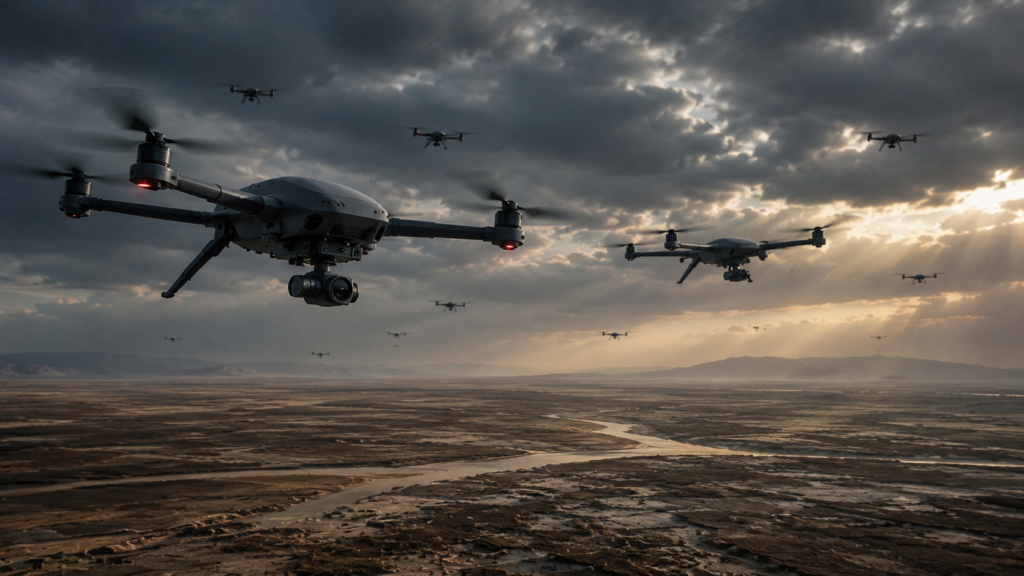
Disclaimer: The views expressed in this opinion article are solely those of the author and do not necessarily reflect the views or editorial position of Global Geopolitical Insight. The accompanying image is AI-generated and is for illustrative purposes only.
About the Author: Abdul Momin Rasul is an MPhil scholar in International Relations at Bahauddin Zakariya University (BZU) and a contributing writer at Global Geopolitical Insight.