
Author: Amna Masood
Abstract
Artificial Intelligence (AI) has emerged as one of the most transformative technologies of the twenty-first century, reshaping global politics, economic systems, military strategies, and international relations. In the modern international order, technological superiority increasingly determines geopolitical influence, making AI a critical arena of competition among major powers. The United States and China currently dominate the global AI ecosystem through advanced semiconductor industries, massive data infrastructures, cloud computing capabilities, and technological innovation. In contrast, Europe faces a strategic challenge: how to preserve technological competitiveness and political autonomy while remaining dependent on foreign digital infrastructure and multinational technology corporations.
This research paper examines Europe’s struggle for digital sovereignty within the broader context of geopolitical competition in artificial intelligence. The study explores the strategic significance of AI, the emergence of digital sovereignty as a political concept, and the European Union’s efforts to establish technological independence through regulatory frameworks, industrial policy, semiconductor initiatives, cybersecurity strategies, and AI infrastructure development.
Using qualitative research methods and secondary data analysis, the paper evaluates major European initiatives including the AI Act, the European Chips Act, Gaia-X, the Digital Services Act (DSA), the Digital Markets Act (DMA), and the Digital Europe Programme. The study further analyzes the geopolitical implications of Europe’s technological dependence on the United States and China, highlighting challenges related to semiconductors, cloud computing, innovation gaps, digital platforms, cybersecurity, and technological fragmentation.
The paper argues that Europe’s digital sovereignty strategy represents a hybrid model combining regulation, industrial policy, ethical governance, and strategic autonomy. However, despite Europe’s strong regulatory influence and industrial capabilities, structural weaknesses continue to limit its ability to compete with dominant technological powers. The study concludes that Europe’s success or failure in achieving digital sovereignty will significantly influence the future global balance of power, international technological governance, and the geopolitical order of the AI era.
1. Introduction
Technology has historically shaped global power structures. From the Industrial Revolution to the nuclear age, states possessing advanced technologies have gained strategic and economic advantages over rivals. In the twenty-first century, artificial intelligence has become the newest frontier of geopolitical competition. AI systems now influence economic productivity, military modernization, cybersecurity, surveillance, communication systems, and political influence. Consequently, nations increasingly view AI not merely as a technological innovation but as a strategic asset directly connected to national security and global influence.
The rapid rise of AI has intensified global competition between major powers, particularly the United States and China. Both countries have invested heavily in AI research, semiconductor production, cloud infrastructure, data collection systems, and military AI applications. American companies such as OpenAI, Microsoft, Google, NVIDIA, and Amazon dominate frontier AI innovation, while China has pursued a state-driven strategy emphasizing technological self-sufficiency and strategic control over digital infrastructure.
Amid this technological rivalry, Europe faces a complex strategic challenge. Although the European Union possesses strong industrial economies, advanced research institutions, and significant regulatory influence, it remains heavily dependent on non-European technology firms for cloud computing, semiconductor manufacturing, AI platforms, and digital infrastructure. This dependence has generated fears regarding strategic vulnerability, economic dependence, and weakened political sovereignty.
To address these concerns, the European Union has increasingly embraced the concept of digital sovereignty. Digital sovereignty refers to the ability of states or political unions to control their digital infrastructure, data governance, technological systems, and cyber capabilities without excessive dependence on external powers.
The European Union’s digital sovereignty agenda aims to strengthen Europe’s position in the global technological order while protecting democratic values, privacy rights, cybersecurity, and economic competitiveness. Through initiatives such as the AI Act, the European Chips Act, Gaia-X, and the Digital Europe Programme, the EU seeks to establish strategic autonomy in critical digital sectors.
However, Europe’s pursuit of digital sovereignty faces multiple challenges, including fragmented markets, limited venture capital ecosystems, technological dependence, talent drain, and competition from American and Chinese technology giants.
This research paper explores Europe’s digital sovereignty struggle within the broader context of geopolitical competition in artificial intelligence.
Research Questions
• Why has artificial intelligence become central to geopolitical competition?
• What strategies has the European Union adopted to strengthen digital sovereignty?
• How will Europe’s digital sovereignty struggle influence the future global order?
Objectives of the Study
• To analyze the geopolitical significance of artificial intelligence.
• To examine Europe’s concept of digital sovereignty.
• To evaluate major European digital and AI-related initiatives.
• To identify the economic, technological, and geopolitical challenges faced by Europe.
• To assess the implications of Europe’s digital sovereignty strategy for global politics.
Significance of the Study
This study is significant because it examines the intersection of technology, geopolitics, economics, and international security in the AI era. Understanding Europe’s digital sovereignty struggle is essential for analyzing future global power structures, international technological governance, cybersecurity dynamics, and strategic competition among major powers.
2. Literature Review
Artificial intelligence has become one of the most widely discussed subjects in international relations, security studies, and global political economy. Scholars increasingly argue that technological superiority is becoming a major determinant of geopolitical influence.
Henry Kissinger, Eric Schmidt, and Daniel Huttenlocher argue that AI represents a transformative force capable of reshaping diplomacy, warfare, and international decision-making. Similarly, Kai-Fu Lee explains that AI competition between the United States and China reflects a broader struggle for technological dominance and economic supremacy.
The concept of digital sovereignty has emerged prominently in European policy discussions. Scholars define digital sovereignty as the capacity of states or regional organizations to exercise authority over digital infrastructure, technological systems, data governance, and cyberspace.
European policymakers argue that technological dependence creates strategic vulnerability. According to the European Parliament, technological sovereignty is necessary for preserving economic resilience, democratic governance, cybersecurity, and political independence.
Research on European digital sovereignty focuses on several themes.
Regulatory Power and the Brussels Effect
Anu Bradford’s theory of the “Brussels Effect” argues that European regulations often become global standards because multinational corporations prefer unified compliance systems. The General Data Protection Regulation (GDPR) is considered one of the strongest examples of Europe’s regulatory influence.
Similarly, scholars believe the AI Act could establish global norms regarding ethical AI governance, transparency, accountability, and risk management.
Technological Dependence
Several studies highlight Europe’s dependence on American cloud computing companies and Asian semiconductor manufacturing. Analysts argue that Europe lacks globally dominant digital platforms comparable to Google, Amazon, Microsoft, Alibaba, or Tencent.
This dependence creates concerns regarding data security, economic vulnerability, and strategic autonomy.
AI and Geopolitical Competition
Security scholars increasingly emphasize the relationship between AI and military modernization. Autonomous weapons systems, predictive intelligence, cyber warfare, and AI-assisted surveillance have become central components of contemporary strategic competition.
Studies further indicate that AI-driven technological leadership influences economic productivity, innovation ecosystems, and global political influence.
Semiconductor Geopolitics
Semiconductors are widely recognized as the foundation of the digital economy and AI systems. Research highlights how supply-chain disruptions and geopolitical tensions surrounding Taiwan and China have increased global concerns regarding semiconductor security.
The European Chips Act emerged partly in response to fears of supply-chain dependency and technological vulnerability.
Gaps in Existing Literature
Although existing literature provides valuable insights into AI governance, European regulation, and technological competition, there remains a need for integrated analysis combining geopolitical, economic, technological, and strategic dimensions.
This research addresses that gap by analyzing Europe’s digital sovereignty struggle within the broader context of AI-driven geopolitical competition.
3. Research Methodology
This research adopts a qualitative research approach based on secondary data analysis.
Sources Used
The study relies on multiple credible sources, including:
• Academic journal articles related to artificial intelligence, geopolitics, cybersecurity, and international relations.
• Reports from international organizations such as the European Union, OECD, NATO, the International Energy Agency, and the United Nations.
• Government policy documents and official EU digital strategy publications.
• Books and scholarly studies on AI governance and technological sovereignty.
• Reports from think tanks including the Atlantic Council, Brookings Institution, Chatham House, and Carnegie Europe.
• Reputable media sources such as Reuters, BBC, Financial Times, Politico Europe, and The Economist.
Research Method
The study employs descriptive and analytical methods to examine:
• The geopolitical importance of artificial intelligence.
• Europe’s digital sovereignty strategy.
• Regulatory and industrial initiatives.
• Technological dependence and structural weaknesses.
• Geopolitical implications of AI competition.
Thematic analysis is used to organize findings under major themes including digital sovereignty, geopolitical rivalry, AI governance, semiconductor competition, cybersecurity, and strategic autonomy.
Limitations of the Study
The research depends primarily on secondary sources and publicly available information. Some reports may reflect institutional or political bias. However, cross-referencing multiple academic and policy sources improves credibility and analytical balance.
4. Artificial Intelligence as a Geopolitical Instrument
Artificial intelligence has become a strategic instrument of national power. Unlike previous technological revolutions limited to specific sectors, AI influences multiple dimensions of state capability simultaneously.
Economic Power
AI enhances productivity, automation, logistics, financial systems, industrial efficiency, and innovation. Countries leading in AI are likely to dominate future economic growth.
According to global economic forecasts, AI could contribute trillions of dollars to the world economy over the next decade.
Military Transformation
Modern militaries increasingly rely on AI for:
• Autonomous weapons systems
• Intelligence gathering
• Surveillance and reconnaissance
• Cybersecurity operations
• Predictive military analysis
• Drone warfare
AI therefore represents a critical component of military modernization.
Cybersecurity and Information Warfare
Artificial intelligence is transforming cyber warfare capabilities. AI systems can identify vulnerabilities, automate cyberattacks, strengthen cyber defense mechanisms, and manipulate information ecosystems.
Disinformation campaigns powered by AI-generated content also pose major risks to democratic systems and political stability.
Data as Strategic Power
AI systems depend heavily on large-scale data collection. Consequently, data has become a strategic resource comparable to oil in the industrial age.
Countries possessing advanced data infrastructures and computational capacity gain substantial geopolitical advantages.
5. The U.S.–China Technological Rivalry
The global AI race is dominated by the United States and China.
The United States
The United States leads global AI innovation through:
• Strong venture capital ecosystems
• Advanced semiconductor companies such as NVIDIA and AMD
• Major AI firms including OpenAI, Google, and Microsoft
• Elite universities and research institutions
• Massive cloud infrastructure capabilities
American dominance in frontier AI models and computational infrastructure provides Washington with immense strategic influence.
China
China has pursued a state-driven AI strategy focused on technological self-sufficiency and strategic control.
Chinese investments in:
• Facial recognition systems
• Smart surveillance
• Semiconductor manufacturing
• AI military applications
• Digital infrastructure projects
have strengthened Beijing’s technological capabilities.
China’s Digital Silk Road initiative further expands its technological influence globally.
Europe Between Two Superpowers
Europe faces a difficult position between these competing technological powers.
While Europe excels in regulation, industrial engineering, and privacy protection, it lacks globally dominant AI firms and hyperscale cloud infrastructure.
This technological imbalance has intensified Europe’s concerns regarding digital dependence.
6. Europe’s Concept of Digital Sovereignty
Digital sovereignty has become a central principle of European digital strategy.
Definition of Digital Sovereignty
Digital sovereignty refers to the ability of states or political unions to control:
• Digital infrastructure
• Data governance systems
• Cloud computing networks
• Cybersecurity mechanisms
• Artificial intelligence systems
• Semiconductor supply chains
without excessive external dependence.
The concept reflects Europe’s desire to maintain strategic autonomy while protecting democratic values, privacy rights, and economic security.
Reasons Behind Europe’s Sovereignty Agenda
Several factors contributed to Europe’s push for digital sovereignty.
Dependence on American Tech Giants
European governments became increasingly concerned about dependence on U.S.-based firms such as Amazon, Google, Apple, Microsoft, and Meta.
Data Privacy Concerns
Mass surveillance revelations and concerns regarding foreign access to European data intensified demands for stronger digital control.
Chinese Technological Expansion
China’s growing technological influence through telecommunications infrastructure and AI systems raised geopolitical concerns.
Supply-Chain Vulnerabilities
The COVID-19 pandemic and semiconductor shortages exposed Europe’s dependence on foreign manufacturing systems.
Cybersecurity Threats
Cyberattacks against European institutions highlighted the importance of secure digital infrastructure.
7. The European Union’s Digital Sovereignty Strategy
The AI Act
The AI Act is the world’s first comprehensive legal framework governing artificial intelligence.
The legislation adopts a risk-based approach:
• Unacceptable-risk AI systems are prohibited.
• High-risk systems face strict regulatory obligations.
• Limited-risk systems require transparency measures.
• Minimal-risk systems remain largely unrestricted.
The AI Act aims to ensure:
• Human oversight
• Transparency
• Accountability
• Ethical AI development
• Protection of fundamental rights
The EU hopes the AI Act will establish global standards for AI governance.
The European Chips Act
Semiconductors are essential for AI systems, cloud computing, and digital technologies.
The European Chips Act aims to:
• Increase Europe’s semiconductor production capacity.
• Strengthen supply-chain resilience.
• Attract investment in advanced chip manufacturing.
• Reduce dependence on Asian suppliers.
The Act reflects Europe’s recognition that semiconductor security is directly linked to geopolitical power.
Gaia-X and Cloud Sovereignty
Gaia-X is a European initiative designed to establish a federated cloud ecosystem based on European legal standards and data governance principles.
The project seeks to reduce Europe’s dependence on American hyperscale cloud providers.
Key goals include:
• Data interoperability
• Transparency
• Digital trust
• European data governance
However, critics argue that Gaia-X faces implementation challenges because many non-European firms remain deeply embedded in Europe’s digital ecosystem.
8. Structural Challenges Facing Europe
Despite ambitious initiatives, Europe faces significant structural obstacles.
Fragmented Digital Markets
Unlike the United States, Europe lacks a fully unified digital market.
Regulatory differences among member states complicate technological scaling and innovation.
Limited Venture Capital
European startups often struggle to secure large-scale investment compared to American firms.
Consequently, many European technology companies relocate abroad.
Talent Drain
Highly skilled European researchers are frequently recruited by American technology corporations offering superior salaries and research environments.
Dependence on Foreign Infrastructure
Europe remains dependent on:
• American cloud services
• Asian semiconductor manufacturing
• Foreign AI platforms
• External digital ecosystems
This dependence limits Europe’s strategic autonomy.
Slow Bureaucratic Processes
Critics argue that excessive regulation and bureaucratic complexity reduce Europe’s innovation capacity.
Some analysts fear that Europe may become a “regulatory superpower but technological underperformer.”
9. Cybersecurity and AI Governance
Cybersecurity has become central to Europe’s digital sovereignty agenda.
Cyber Threats
European institutions increasingly face cyber threats from:
• State-sponsored actors
• Criminal organizations
• Hacktivist networks
• AI-assisted cyberattacks
The integration of AI into cyber warfare intensifies security concerns.
Ethical AI Governance
Europe promotes a “human-centric” AI model emphasizing:
• Human rights
• Democratic accountability
• Transparency
• Privacy protection
• Ethical innovation
European policymakers argue that technological progress must remain compatible with democratic values.
10. Geopolitical Implications
Transatlantic Relations
Europe’s digital regulations have created tensions with the United States.
American technology companies often criticize European regulations as restrictive and protectionist.
However, Europe and the United States remain strategic allies within NATO and broader Western alliances.
This creates a complicated relationship combining cooperation and technological competition.
Europe and China
Europe’s relationship with China is similarly complex.
China represents:
• A major economic partner
• A technological competitor
• A geopolitical challenge
European policymakers remain cautious regarding Chinese involvement in telecommunications and digital infrastructure.
Strategic Autonomy and Multipolarity
Europe’s sovereignty strategy reflects a broader transition toward a multipolar technological order.
The struggle for digital sovereignty demonstrates that technology increasingly shapes geopolitical alignments and strategic influence.
11. Future of Europe’s AI Ambitions
Europe’s future role in global AI competition will depend on several factors.
Investment in Innovation
Europe must significantly increase investment in:
• AI research
• Semiconductor manufacturing
• Supercomputing infrastructure
• Quantum computing
• Digital education
Strengthening the Single Digital Market
A more integrated European digital market could improve innovation and competitiveness.
Public–Private Partnerships
Collaboration between governments, universities, and private companies will be essential for technological advancement.
Strategic Cooperation
Europe may pursue selective technological cooperation with democratic allies while reducing excessive dependence.
12. Conclusion and Recommendations
Artificial intelligence has transformed global geopolitics by linking technological leadership with economic power, military capability, and strategic influence. In this emerging technological order, Europe faces a profound challenge: how to preserve strategic autonomy and democratic values while competing against technologically dominant powers such as the United States and China.
The European Union’s digital sovereignty strategy represents one of the most ambitious attempts to redefine technological governance in the modern era. Through initiatives such as the AI Act, the European Chips Act, Gaia-X, the Digital Services Act, and the Digital Markets Act, Europe seeks to establish greater control over digital infrastructure, data governance, cybersecurity, and artificial intelligence.
However, Europe’s ambitions are constrained by structural weaknesses including fragmented markets, technological dependence, limited venture capital ecosystems, semiconductor vulnerabilities, and reliance on foreign cloud providers.
Despite these challenges, Europe possesses important strengths:
• Strong regulatory influence
• Advanced industrial economies
• World-class research institutions
• Democratic governance frameworks
• Semiconductor expertise through ASML
• Growing awareness of strategic technological risks
Europe’s struggle for digital sovereignty ultimately reflects a broader transformation in international politics where technology, economics, and security are increasingly interconnected.
The future global order may depend not only on military alliances and economic power but also on who controls algorithms, semiconductors, data, and computational infrastructure.
Recommendations
Increased Investment in AI Infrastructure
European governments should increase funding for AI research centers, semiconductor manufacturing, and high-performance computing systems.
Strengthening Technological Independence
The EU should reduce excessive dependence on foreign cloud providers and digital platforms through indigenous technological development.
Promoting Innovation Ecosystems
Europe must encourage venture capital investment, startup growth, and public-private technological partnerships.
Cybersecurity Cooperation
European states should strengthen cybersecurity coordination to protect digital infrastructure and critical systems.
Educational and Digital Skill Development
Investment in AI education, technical training, and digital literacy programs is necessary to develop a competitive workforce.
International Cooperation
Europe should cooperate with democratic allies to establish international AI governance standards while preserving strategic autonomy.
In conclusion, Europe’s digital sovereignty struggle represents one of the defining geopolitical challenges of the AI era. Its outcome will shape the future of technological governance, global power competition, cybersecurity, and the international political order.
References
- Bradford, Anu. The Brussels Effect: How the European Union Rules the World. Oxford University Press, 2020.
- Kissinger, Henry, Eric Schmidt, and Daniel Huttenlocher. The Age of AI. Little, Brown and Company, 2021.
- European Commission. European Approach to Artificial Intelligence.
- European Commission. European Chips Act.
- European Parliament Reports on Technological Sovereignty.
- OECD Reports on Artificial Intelligence and Digital Governance.
- NATO Emerging and Disruptive Technologies Strategy.
- Kai-Fu Lee. AI Superpowers: China, Silicon Valley, and the New World Order.
- Brookings Institution Reports on AI Geopolitics.
- Atlantic Council Reports on Digital Sovereignty.
- Reuters Reports on European AI Regulation.
- Financial Times Analysis on Europe’s Technology Policies.
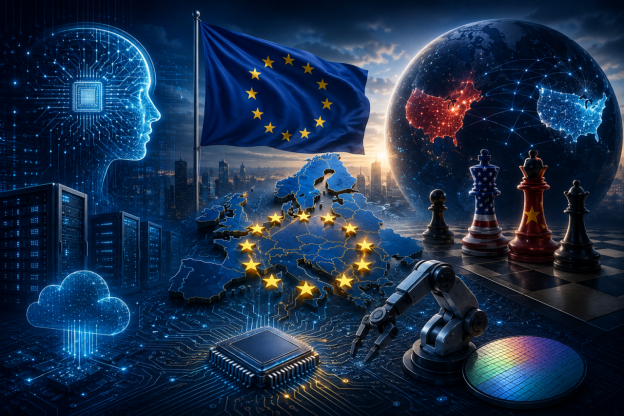
Note: Image is AI generated for reference
About the Author:
Amna Masood is a Geopolitical Analyst and BS International Relations Student at National University of Modern Languages, Rawalpindi, Research Focus: Geopolitics of Europe