
Introduction
For decades, tariffs were viewed as ordinary economic tools. Governments imposed them to protect domestic industries from foreign competition, generate revenue, or correct trade imbalances. They rarely attracted public attention and were largely confined to discussions among economists, trade negotiators, and finance ministries. Today, however, tariffs have moved far beyond their traditional role. They have become powerful instruments of geopolitical competition, used to influence foreign governments, reshape strategic relationships, and pursue foreign policy objectives that often have little to do with trade itself.
This transformation reflects a broader shift in international politics. As military confrontation becomes increasingly costly and economic interdependence deepens, governments are turning to trade as a means of exerting pressure without resorting to armed conflict. Tariffs are now being imposed not only to protect domestic markets but also to influence decisions on energy security, technology, border management, and strategic alliances. Recent actions by the United States against China, India, Canada, and Mexico illustrate how trade policy has become an extension of foreign policy.
Yet the growing use of tariffs as geopolitical weapons raises an important question: Do they actually achieve their intended objectives, or do they impose greater costs on the countries that introduce them? The evidence suggests that while tariffs can create short-term political leverage, they often produce unintended economic consequences, encourage countries to diversify their trade partnerships, and accelerate the fragmentation of the global trading system.
From Economic Protection to Geopolitical Pressure
The use of trade restrictions for political purposes is not entirely new. Throughout history, states have employed economic measures to weaken rivals or influence their behaviour. During the Cold War, export controls and trade embargoes were used to restrict access to strategic technologies. Economic sanctions against countries such as Iran and Russia have similarly demonstrated how commerce can serve political objectives.
However, today’s tariff policies differ in one important respect. Unlike traditional tariffs, which were designed primarily to protect domestic industries or address unfair trade practices, modern tariffs increasingly target issues unrelated to trade. Governments now use them to influence foreign policy decisions, discourage strategic partnerships, and alter national behaviour on matters ranging from energy imports to immigration enforcement.
The appeal of tariffs is easy to understand from a political perspective. Unlike military action, tariffs involve no deployment of troops. Unlike comprehensive sanctions, they can often be imposed quickly through executive authority without requiring extensive international coordination. They allow governments to project strength, satisfy domestic political audiences, and signal resolve while avoiding the risks associated with military escalation.
For political leaders, tariffs have therefore become an attractive instrument that lies somewhere between diplomacy and economic sanctions. Their immediate visibility often makes them politically rewarding, even when their long-term effectiveness remains uncertain.
The US-China Trade War: The Defining Example
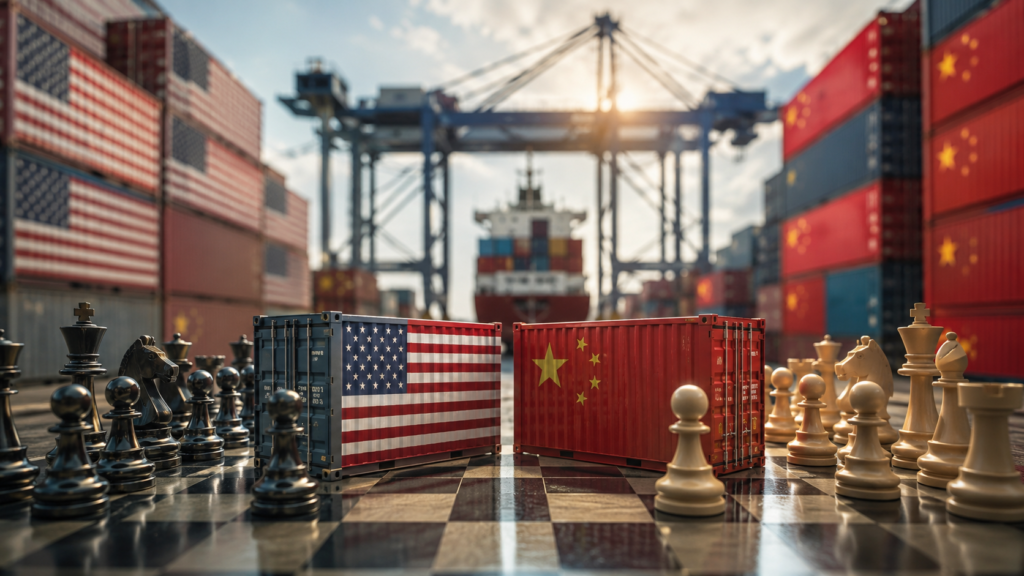
No recent example better illustrates the weaponization of trade than the ongoing tariff confrontation between the United States and China.
What began as concerns over trade imbalances and intellectual property gradually expanded into a broader strategic rivalry involving technology, national security, semiconductor production, rare earth minerals, and geopolitical influence. By early 2025, the United States imposed new tariffs on Chinese imports, citing concerns related to fentanyl trafficking and national security. China responded with retaliatory tariffs targeting American agricultural products, energy exports, and industrial goods.
Within months, both countries dramatically escalated their tariff rates, pushing them to levels rarely seen in modern international trade. Rather than simply discouraging imports, these measures effectively became instruments of strategic competition between the world’s two largest economies.
Despite these unprecedented tariffs, however, the results were mixed. While trade patterns changed significantly, China’s overall export performance remained remarkably resilient. Chinese manufacturers increasingly redirected exports toward Southeast Asia, the European Union, the Middle East, and other emerging markets. Instead of collapsing under tariff pressure, China diversified its trading relationships and reduced its dependence on the American market.
This experience highlights an important limitation of tariff diplomacy. In a highly interconnected global economy, countries rarely depend on a single export destination. When one market becomes less accessible, businesses often seek alternative buyers. As a result, tariffs frequently redirect trade rather than eliminate it altogether.
Tariffs Beyond Trade
The expanding use of tariffs against countries other than China demonstrates how trade policy has evolved into a broader geopolitical tool.
India provides one of the clearest examples. In 2025, the United States imposed steep tariffs on Indian goods, not because of unfair trade practices but because India continued purchasing discounted Russian oil following Western sanctions on Moscow. The tariffs affected sectors such as textiles, leather products, gems, and jewellery, even though these industries had little connection to the geopolitical dispute over energy imports.
Eventually, diplomatic negotiations contributed to a reduction in tariff rates after India adjusted some of its energy purchasing decisions. Whether this represented a successful use of economic pressure or simply imposed unnecessary costs on both sides remains a matter of debate. Nevertheless, the episode demonstrated that tariffs are increasingly being used to influence foreign policy choices rather than commercial practices.
Canada and Mexico experienced similar pressure when tariffs were linked to concerns over fentanyl trafficking and border security rather than conventional trade disputes. Instead of addressing issues such as subsidies or dumping, trade measures were employed to encourage greater cooperation on migration and law enforcement.
Even earlier examples reveal this trend. In 2018, the United States doubled tariffs on Turkish steel and aluminium during a diplomatic dispute over the detention of an American pastor. Although officially justified on economic grounds, the move was widely interpreted as an attempt to increase political pressure on Ankara. Such cases illustrate how tariffs have gradually evolved into instruments of diplomatic coercion.
The Hidden Costs of Tariff Wars
Although tariffs are often presented as penalties imposed on foreign countries, economic reality is considerably more complex.
A tariff is ultimately a tax on imported goods. In many cases, the importing company initially pays the tariff, but much of the additional cost is eventually passed on to consumers through higher prices. Businesses facing increased production costs often raise prices, reduce investment, or search for alternative suppliers.
Research conducted by several American economic institutions indicates that a substantial share of recent tariff costs has been absorbed by domestic businesses and households rather than foreign exporters. Higher prices for consumer electronics, furniture, automobiles, industrial equipment, and construction materials have increased living costs for many families.
Small businesses are particularly vulnerable because they often lack the financial capacity to absorb sudden increases in import costs. Unlike multinational corporations, smaller firms cannot easily relocate supply chains or negotiate lower prices with suppliers. Many are forced either to increase prices or reduce profit margins, making them less competitive.
Agriculture provides another important example. During the earlier phase of the US-China trade dispute, China sharply reduced purchases of American soybeans and other agricultural products in response to US tariffs. The resulting losses forced the US government to provide billions of dollars in financial assistance to affected farmers. Ironically, taxpayers ultimately financed compensation for industries harmed by policies originally intended to strengthen the American economy.
These experiences demonstrate that tariffs rarely impose costs exclusively on foreign governments. Instead, they create complex economic burdens that are shared across businesses, consumers, and taxpayers.
A Fragmenting Global Trading System
Perhaps the most significant consequence of tariff diplomacy is not the immediate economic disruption but the long-term restructuring of global trade.
Countries increasingly recognise the risks associated with excessive dependence on any single market. As geopolitical tensions have intensified, governments have accelerated efforts to diversify trade relationships and strengthen regional economic partnerships.
The European Union has expanded trade agreements with several partners, while negotiations with additional economies continue. The United Kingdom has strengthened commercial ties with India and joined the Comprehensive and Progressive Agreement for Trans-Pacific Partnership (CPTPP), opening new opportunities across the Indo-Pacific region.
Also Read: US-Iran 14-Point Peace Plan Explained: Key Provisions, Global Impact, and Future Prospects
At the same time, emerging economies have sought greater cooperation through platforms such as BRICS, reflecting broader efforts to reduce dependence on traditional Western markets and financial systems. While these initiatives remain works in progress, they illustrate an important trend toward a more diversified global trading environment.
This shift has significant geopolitical implications. Every new trade agreement signed outside the framework of major tariff disputes reduces the leverage that unilateral tariffs can exert in the future. Countries with multiple trading partners become less vulnerable to pressure from any single market.
Moreover, the growing reliance on unilateral tariffs has weakened confidence in the rules-based international trading system established after the Second World War. The World Trade Organization, once regarded as the principal forum for resolving trade disputes, has struggled to address increasingly politicised economic conflicts. As governments bypass multilateral institutions in favour of unilateral action, the predictability that once characterised global trade has gradually diminished.
Can Tariffs Achieve Their Strategic Goals?
Tariffs are not entirely ineffective. In certain circumstances, they can encourage limited policy adjustments or bring governments to the negotiating table. Countries facing heavy dependence on a particular export market may choose compromise rather than prolonged economic disruption.
However, achieving broader strategic objectives is considerably more difficult.
Recent experience demonstrates that tariffs have not fundamentally transformed China’s economic model, eliminated American trade deficits, or significantly reduced global dependence on Chinese manufacturing. Instead, they have encouraged supply-chain diversification, expanded alternative trade partnerships, and accelerated investment in domestic production across multiple regions.
Similarly, while tariffs may temporarily influence individual policy decisions, they rarely produce lasting changes in national strategic priorities. Governments often adapt by identifying new export markets, strengthening regional partnerships, or investing in domestic industries that reduce future vulnerability.
In this sense, tariffs resemble other forms of economic coercion. They can create pressure, but they cannot always guarantee political compliance.
Conclusion
The growing weaponization of tariffs reflects a broader transformation in international politics, where economic interdependence has become both a source of prosperity and a tool of strategic competition. Trade policy is no longer confined to questions of imports, exports, and industrial protection. It has become an instrument through which states pursue geopolitical influence, national security objectives, and diplomatic leverage.
Yet the effectiveness of this strategy remains uncertain. While tariffs may deliver short-term political gains and occasionally secure limited concessions, they also increase costs for domestic consumers and businesses, disrupt global supply chains, and encourage countries to diversify their economic relationships. Rather than reinforcing economic dominance, excessive reliance on tariffs may gradually reduce the very leverage they are intended to create.
As the international economy becomes increasingly multipolar, governments are adapting by expanding regional trade agreements, investing in alternative supply chains, and reducing dependence on any single market. The result is a more fragmented global trading system in which unilateral tariff measures become progressively less effective over time.
Ultimately, tariffs have become one of the defining instruments of twenty-first-century geopolitics. Whether they will be remembered as effective tools of statecraft or as politically attractive policies with limited strategic success will depend not only on the concessions they secure but also on the lasting impact they leave on the future of the global economic order.
Note: Image is AI generated and for reference