
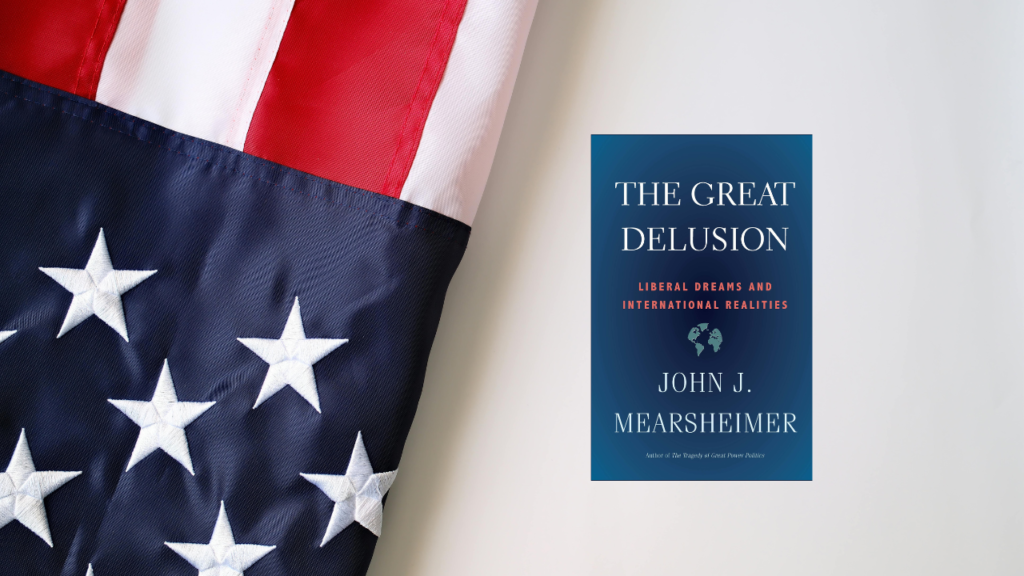
Book: The Great Delusion: Liberal Dreams and International Realities
Author: John J. Mearsheimer
Publisher: Yale University Press (2018)
Pages: 313
Genre: International Relations, Political Science
Introduction
The Great Delusion: Liberal Dreams and International Realities is a major work by American international relations scholar John J. Mearsheimer, published in 2018 by Yale University Press. In this book, Mearsheimer challenges the dominant ideas of post–Cold War American foreign policy, particularly the belief in liberal hegemony — the idea that the United States should spread liberal democracy and its values around the world. Instead, he argues for a more restrained foreign policy grounded in realism and a clear understanding of global political forces. The book has sparked significant scholarly discussion and debate in international relations.
Summary of the Content
Mearsheimer begins by examining the rise of liberal hegemony in U.S. foreign policy after the end of the Cold War. He defines liberal dreams as the idea that states can and should transform the international system by spreading democratic values, creating international institutions, and building an open global economy. According to him, this idealistic approach has led the United States into costly conflicts and created instability rather than peace.
The author contrasts liberal dreams with international realities. He argues that nationalism and the anarchic structure of the international system ultimately determine state behaviour. Because there is no world government, states must prioritise their security and interests, often at the expense of liberal ideals. Realism, Mearsheimer maintains, offers a more accurate framework for understanding foreign policy because it acknowledges these limits.
Mearsheimer also critiques the assumption that military interventions and nation‑building can create stable democratic societies. He points to U.S. engagements in Iraq, Libya, and Afghanistan as examples where liberal goals produced negative outcomes, undermining global stability and America’s own security.
Critical Evaluation
Mearsheimer’s arguments are clear, forceful, and grounded in a realist theoretical framework. His critique of liberal hegemony is persuasive, especially when he highlights how attempts to reshape political systems abroad have led to prolonged conflicts instead of lasting peace. Many reviewers describe the book as a powerful indictment of post‑Cold War foreign policy, exposing the limits of liberal ambitions in an international system governed by power politics.
Several scholars participating in roundtable discussions appreciate the book’s clarity, relevance, and its challenge to widely held assumptions about U.S. foreign policy. They note that the realist argument reinforces the idea that nationalism and balance‑of‑power dynamics continue to dominate world politics, even in an era of economic interdependence and global institutions.
However, some critics argue that while Mearsheimer effectively identifies problems with liberal hegemony, his alternative — a purely realist approach — may oversimplify the potential for cooperation and the role international institutions can play in managing global challenges. Critics suggest that the book would benefit from integrating realism with more nuanced theories that consider the benefits of strategic cooperation under certain conditions.
Significance and Impact
The book holds significant value for students of international relations, policymakers, and anyone interested in understanding the limits of idealistic foreign policy strategies. Mearsheimer’s critique has influenced debates about U.S. engagement in the Middle East, NATO’s role, and how states should respond to global challenges like terrorism, migration, and great power competition. His work continues to shape discussions on whether liberal internationalism remains viable or if nations must adopt more restrained, realist policies.
Mearsheimer’s status as a leading realist scholar (best known for The Tragedy of Great Power Politics) adds weight to his critique. His arguments reflect decades of research into how power, security, and national interests interact in global politics, making this book an important follow‑up to his earlier foundational work in international relations theory.
Conclusion
The Great Delusion: Liberal Dreams and International Realities is a compelling, well‑argued critique of liberal hegemony in American foreign policy. Mearsheimer convincingly demonstrates that liberal ideals, when used to justify interventionist policies, often fail to achieve intended outcomes and may undermine global stability. His realist perspective serves as a valuable corrective to idealistic assumptions and offers an alternative framework that prioritises national interest and geopolitical realities. While some critics contend that the book may underplay the positive roles of cooperation and institutions, it remains an essential read for those seeking to understand the strategic choices facing global powers in the post‑Cold War era.