
Author: Menahil Hasna Awan
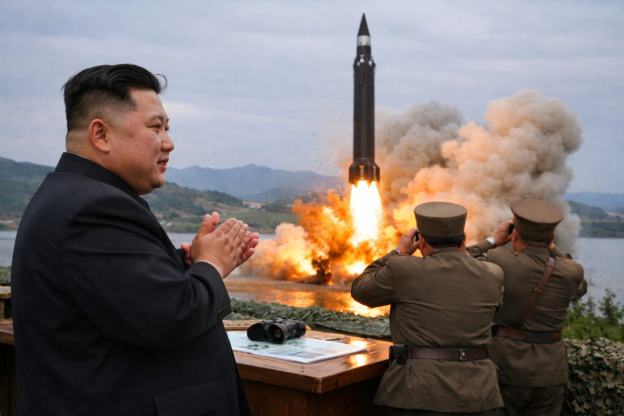
Pyongyang (GGPI): On April 19th 2026, North Korea launches its ballistic missiles again, sowing its Defence capabilities amidst Iran-Isreal-US war.
North Korean President Kim Jong Un addressed senior party officials in early 2026 at a key meeting of the Workers’ Party of Korea, reinforcing North Korea’s commitment to strengthening its military and nuclear capabilities. Shortly afterward, the country conducted another round of ballistic missile launches into the sea, marking its fourth launch this month and the seventh so far this year.
These repeated tests are not random. Analysts view them as a calculated strategy by Pyongyang to demonstrate its military readiness and assert its position in an increasingly tense international environment. In particular, the ongoing US-Israel war with Iran appears to have influenced North Korea’s actions. South Korean former presidential security advisor Kim Ki-Jung said that ‘Pyongyang may be drawing lessons from Iran’s situation, aiming to highlight its own “self-defence capabilities” and reinforce the importance of nuclear deterrence for regime survival.
Read More: Hypersonic Missiles and Global Security: Shifting the Strategic Balance
At the same time, the missile launches also serve a diplomatic purpose. North Korea often uses military demonstrations to gain leverage before potential negotiations. There has been renewed discussion about possible talks involving the US and South Korea, with US President Donald Trump and South Korean President Lee Jae Myung both expressing interest in engaging with Pyongyang. By showcasing its military strength, North Korea signals that it intends to negotiate from a position of power rather than vulnerability.
Technically, the missiles were launched from near Sinpo , a coastal city known for submarine facilities, raising the possibility that North Korea is advancing its submarine-launched ballistic missile (SLBM) capabilities. Although the missiles traveled a relatively short distance of around 140 kilometers, the location and frequency of launches are strategically significant.
Meanwhile, concerns about North Korea’s nuclear program continue to grow. The International Atomic Energy Agency (IAEA) has reported “very serious” progress, including potential expansion of uranium enrichment facilities. This indicates that Pyongyang is not only testing delivery systems but also strengthening its capacity to produce nuclear weapons.
Overall, North Korea’s recent actions reflect a dual strategy: strengthening deterrence while shaping the diplomatic environment. The combination of military escalation and openness to dialogue highlights a familiar pattern in Pyongyang’s foreign policy—using pressure to create opportunities for negotiation.
Note: Image is AI generated and for reference.
About the Author: Menahil Hasna Awan (Geopolitical Analyst and BS International Relations Student at National University of Modern Languages , Rawalpindi, Research Fellow at Global Geopolitical Insight, Research focus : Defence Studies)