
Abstract
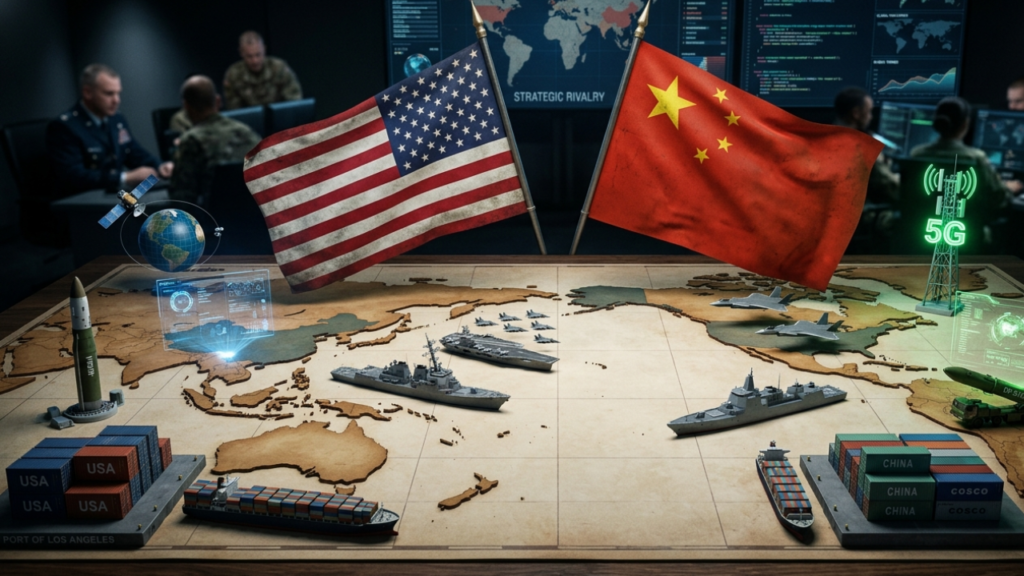
The 21st century has witnessed the rise of China as a global power, challenging the long-standing dominance of the United States. This strategic rivalry is reshaping global politics, trade, technology, and security. This paper examines the historical roots of US-China relations, analyzes the economic, military, and technological dimensions of their competition, and explores the impact of this rivalry on regional and global stability. Using qualitative research methods, including analysis of policy documents, scholarly literature, and media reports, the paper highlights key trends and provides insights for policymakers. The study concludes that the US-China rivalry will define global power structures in the 21st century, necessitating careful diplomatic, economic, and strategic planning to avoid conflicts while managing competition.
1. Introduction
The world in the 21st century is witnessing a transformation in global power structures. The United States, the preeminent superpower since the end of the Cold War, faces a growing challenge from China, whose rapid economic growth, technological advancement, and increasing global influence have altered international relations. This strategic rivalry is not limited to economic competition but extends to military, technological, and diplomatic arenas.
Historically, US-China relations have oscillated between cooperation and competition. The United States welcomed China’s economic reforms in the late 20th century, viewing China as a partner in global trade. However, in recent years, tensions have risen due to trade disputes, territorial conflicts, and contrasting geopolitical visions. The rivalry is particularly evident in the Indo-Pacific region, technological race, and influence over multilateral institutions.
Research Questions:
- What are the historical roots of US-China strategic rivalry?
- How do economic, military, and technological factors contribute to this competition?
- What are the implications of this rivalry for global politics and regional security?
Objectives:
- To analyze the historical context of US-China relations.
- To examine the key dimensions of strategic competition.
- To assess the global implications of the rivalry.
This research uses qualitative methods, relying on secondary sources such as scholarly articles, government reports, and reputable news sources, ensuring an evidence-based analysis of the US-China rivalry.
2. Literature Review
Scholars have studied US-China relations from multiple perspectives, including geopolitics, economics, and security studies. Mearsheimer (2014) argues that the rise of China is a structural challenge to the United States, predicting an inevitable conflict under the theory of offensive realism. On the other hand, Ikenberry (2011) emphasizes the possibility of cooperation through international institutions and economic interdependence.
Economic studies highlight China’s rapid industrial growth, export-oriented economy, and technological advancements. According to the World Bank (2023), China’s GDP surpassed $18 trillion, making it the second-largest economy globally. This growth has allowed China to expand its influence through initiatives such as the Belt and Road Initiative (BRI), reshaping global trade networks.
Military studies indicate a significant modernization of China’s armed forces. The U.S. Department of Defense (2022) reports that China has developed advanced missile systems, naval capabilities, and cyber warfare technology, challenging U.S. dominance in the Indo-Pacific. Analysts argue that the growing military capabilities increase the potential for regional conflicts, especially in the South China Sea and Taiwan Strait.
Technological competition is another crucial dimension. The race for artificial intelligence, 5G, quantum computing, and semiconductors reflects the strategic importance of technology in determining global power. Scholars such as Allison (2017) describe this as a “Thucydides Trap,” where a rising power challenges an established power, potentially leading to conflict.
In summary, existing literature provides a multi-dimensional understanding of the US-China rivalry. However, there is a need to integrate historical, economic, military, and technological factors into a comprehensive framework for understanding its global implications.
3. Methodology
This research adopts a qualitative approach, using secondary data analysis. Sources include:
- Scholarly articles from journals of international relations, security studies, and economics.
- Government and institutional reports from the U.S. Department of Defense, Ministry of Foreign Affairs of China, World Bank, and United Nations.
- Media sources such as The New York Times, BBC, and DAWN to capture current developments.
The study uses descriptive and analytical methods to evaluate trends, compare policies, and assess implications. The data is analyzed thematically under four dimensions: historical context, economic competition, military rivalry, and technological advancement.
Limitations include reliance on secondary data and potential bias in media sources. However, cross-verification among multiple sources ensures credibility and reliability of findings.
4. Historical Context of US-China Relations
The US-China relationship dates back to the 18th century but became strategically important in the 20th century. During the Cold War, the United States initially viewed China with suspicion due to its communist regime. However, in the 1970s, President Richard Nixon initiated rapprochement, resulting in improved diplomatic and economic ties. This cooperation facilitated China’s opening to global trade and foreign investment.
Post-Cold War, the United States maintained a policy of engagement, expecting China to liberalize politically while integrating economically. However, China’s rise has challenged this assumption. The 21st century has seen a shift from engagement to strategic competition, as China asserts its influence regionally and globally. Key historical milestones include:
- 1999: U.S. bombing of the Chinese embassy in Belgrade, causing tensions.
- 2001: China joins the World Trade Organization (WTO), marking deeper economic integration.
- 2010s: South China Sea disputes and Belt and Road Initiative highlight geopolitical ambitions.
These events set the stage for a rivalry characterized by competition in economics, military strength, and diplomacy.
5. Economic Competition
China’s economic rise is central to the strategic rivalry. Its GDP growth, export dominance, and trade surplus have led to tensions with the United States. The trade war initiated in 2018 reflected disputes over tariffs, intellectual property theft, and market access.
China’s Belt and Road Initiative expands its economic influence across Asia, Africa, and Europe, challenging U.S.-led institutions. Meanwhile, the U.S. promotes economic alliances like the Indo-Pacific Economic Framework to counter China’s influence.
Economic interdependence between the two powers creates both cooperation and friction. U.S. companies benefit from Chinese markets, but political and strategic concerns often conflict with economic interests. Analysts argue that the economic dimension of rivalry will shape global supply chains, trade policies, and development strategies.
6. Military and Strategic Rivalry
Military modernization is another key aspect. China has invested heavily in naval expansion, missile technology, and cyber capabilities. The South China Sea, Taiwan Strait, and East China Sea are flashpoints for potential conflict.
The United States maintains a network of alliances, including Japan, South Korea, and Australia, to preserve security in the Indo-Pacific. The presence of U.S. aircraft carriers, joint military exercises, and arms sales to regional partners reflects a strategy of deterrence.
Experts emphasize the risks of miscalculation. An incident in the Taiwan Strait or South China Sea could escalate tensions rapidly. Therefore, both powers engage in diplomacy alongside military preparedness to manage risks.
7. Technological Competition
Technological supremacy is central to strategic power. China aims to lead in artificial intelligence, 5G, quantum computing, and semiconductors. U.S. policies, including export controls on high-tech equipment and restrictions on Chinese companies, reflect the importance of technology in national security.
Cybersecurity and cyber warfare capabilities are also critical. China and the U.S. engage in cyber operations to protect national interests and project power. Technology not only drives economic growth but also enhances military and diplomatic influence, making it a key dimension of the rivalry.
8. Diplomacy and Regional Influence
Diplomatic competition is evident in Asia, Africa, and Latin America. China’s engagement through economic assistance, infrastructure projects, and multilateral forums expands its influence. The U.S. counters with strategic alliances, aid programs, and defense partnerships.
Regional conflicts, such as North Korea’s nuclear program or tensions in the South China Sea, require careful diplomacy. Both powers use soft power, cultural exchanges, and international institutions to assert influence, reflecting a rivalry that is not only military and economic but also diplomatic.
9. Implications for Global Politics
The US-China rivalry has significant implications:
- Global Order – Challenges the unipolar world dominated by the U.S. and encourages multipolarity.
- Regional Stability – Increases risks in Asia-Pacific, Middle East, and Africa due to competing alliances.
- Economic Systems – Potential decoupling of supply chains and competition over trade rules.
- International Institutions – Pressure on the UN, WTO, and other organizations to balance interests.
The rivalry shapes policies of other countries, forcing them to align strategically, economically, or diplomatically. Smaller states face challenges in balancing relations between the two powers.
10. Conclusion and Recommendations
The US-China strategic rivalry is the defining feature of 21st-century geopolitics. It spans economic competition, military modernization, technological supremacy, and diplomatic influence. While rivalry is inevitable due to structural power shifts, conflict is not predetermined.
Recommendations:
- Diplomacy First – Strengthen communication channels to avoid miscalculations.
- Multilateral Cooperation – Use international institutions to manage disputes.
- Economic Engagement – Promote mutually beneficial trade while protecting strategic industries.
- Regional Stability – Support ASEAN, South Asian, and Pacific frameworks for conflict resolution.
Managing this rivalry requires a balance between competition and cooperation, ensuring global stability while recognizing the rise of China as a major power.
Note: Image is AI generated and for reference