
Introduction
The global political landscape in 2026 is markedly different from that of the late 20th century. The United States, historically viewed as the primary global power, now operates within a multipolar world where influence is shared among several states, regional blocs, and institutions. This new order is shaped by economic competition, technological transformation, evolving military balances, and diplomatic negotiations. Understanding how the United States adjusts its approach in this context is essential for assessing future patterns of global leadership.
The shift away from a strictly unipolar global system toward multipolarity reflects broader changes in the international system, including the growing importance of emerging powers, shifting alliances, and evolving economic networks. Multipolarity does not mean the absence of strong powers. Rather, it means that no single country holds undisputed dominance, and that global influence is more distributed among major actors, regional organizations, and transnational processes. This article examines how the United States navigates this environment, the challenges it faces, and the implications for the global order.
Historical Context: America’s Long‑Term Influence
During the second half of the 20th century and the early 2000s, the United States played a central role in shaping the global system. Institutions such as the United Nations, the International Monetary Fund, the World Bank, and alliances like NATO were part of a framework that reflected, to a large degree, U.S. influence. These structures facilitated cooperation on issues ranging from collective security to economic stability and post‑war reconstruction.
Over time, this arrangement shifted. After the Cold War, the United States held a unique position in global affairs, sometimes described as a unipolar moment. However, international events of the early 21st century—including economic crises, regional conflicts, and the rise of other powerful actors—challenged assumptions about singular leadership. Analysts now widely recognize that global affairs are increasingly shaped by multiple power centers rather than dominance by one state alone.
Understanding Multipolarity
Multipolarity refers to a global structure where several states possess significant influence across economic, military, and diplomatic domains. In the modern context, a multipolar world includes diverse actors such as China, the United States, the European Union, Russia, India, and others. Each of these influences global issues in different ways, contributing to a more balanced and complex power landscape.
One driver of multipolarity is the growth of major states in sectors such as trade, technology, and innovation. For example, shifts in global manufacturing, finance, and digital infrastructure have allowed countries beyond the traditional Western powers to assert strategic significance. This shift is reinforced by changing alliances, regional institutions, and global challenges that require collective problem‑solving rather than unilateral decision‑making.
The United States remains essential in this structure, but its role operates within a broader constellation of influential actors rather than in isolation.
Economic Dimensions of a Multipolar World
Economic strength has long been a pillar of national influence. The United States maintains a leading position in global finance, innovation, and high‑value sectors such as technology, medicine, and advanced manufacturing. The U.S. dollar continues to function as a major reserve currency, and American institutions remain central in global economic architecture.
At the same time, economic competition is intensifying. China’s expanding economic footprint, robust trade networks, and investment in global infrastructure have contributed to a more diversified economic order. Regional economies in Asia, Africa, and Latin America are becoming more integrated into global value chains, reducing dependence on any single market. Emerging markets now contribute a larger share of global growth than in past decades, making economic leadership more distributed across regions.
In addition, debates around supply chain resilience and diversification have become prominent. Businesses and governments increasingly seek to balance efficiency with strategic security in critical sectors such as semiconductors, energy technologies, and rare earth minerals. This trend reflects a broader geoeconomic shift in which economic policy and strategic considerations are deeply intertwined.
Military Power and Strategic Balance
The United States continues to maintain significant military capabilities, including advanced technologies, global deployment capacity, and extensive alliance networks. Military strength remains central to national strategy, particularly in areas such as deterrence, rapid response, and coalition operations.
At the same time, other states are enhancing their own strategic capabilities, prompting shifts in regional and global military balances. In the Indo‑Pacific, for instance, several nations are investing in modernizing defense forces and strengthening regional security cooperation. In Europe, collective defense initiatives and NATO activities respond to ongoing security challenges. One recent example is NATO’s Arctic Sentry mission, launched in early 2026 to enhance presence and coordination among member states in the Arctic region amid changing strategic conditions in the High North.
The evolving military landscape emphasizes not only traditional defense capabilities but also emerging domains such as cyber security, space, and unmanned systems. As these domains grow in importance, military strategy increasingly includes technological competition and information security as core components.
Diplomacy and Alliance Networks
Diplomatic engagement remains a central tool for advancing foreign policy objectives and managing complex international relationships. In a multipolar world, diplomacy often involves coordinating with multiple partners, balancing competing interests, and negotiating collective responses to shared challenges.
The United States engages in a variety of diplomatic efforts, including multilateral negotiations, strategic alliances, and regional partnerships. One example of ongoing diplomacy is the series of trilateral meetings held in 2026 between the United States, Ukraine, and Russia, focusing on parameters for managing conflicts and seeking avenues for negotiations. These talks reflect an effort to engage directly with complex security issues through diplomatic channels involving multiple actors, rather than through unilateral decisions.
Diplomacy also involves cooperation on transnational challenges such as climate change, global health, economic instability, and humanitarian crises. Collective action on these issues often requires consensus‑building among diverse states with differing priorities and perspectives. This aspect of modern diplomacy emphasizes negotiation, compromise, and shared frameworks that respect multiple viewpoints.
Adaptation in Foreign Policy Strategy
In responding to the multipolar world, the United States has adjusted aspects of its foreign policy approach over time. Historically, U.S. policy incorporated a wide range of objectives including security alliances, economic engagement, and ideological commitments. In recent years, strategic priorities have broadened to reflect the complex realities of a diversified global order.
For example, U.S. foreign policy toward East Asia incorporates a blend of alliance commitments, economic cooperation, and diplomatic engagement to balance regional stability with economic interests. This includes initiatives related to trade, technology partnerships, and security cooperation with several regional states.
Adjustments also involve recognizing that global leadership no longer means acting alone. Instead, effective influence often depends on building consensus, supporting shared norms, and engaging in collaborative frameworks that respect the interests of multiple partners.
Technological Competition and Cooperation
Technology is a defining element of 21st‑century strategic competition. Innovations in artificial intelligence, telecommunications, quantum computing, space systems, and biotechnology have become deeply intertwined with geopolitics. States that lead in these domains can influence global standards, economic growth, and national security trajectories.
The United States continues to be a major innovator, with a vibrant private sector and substantial research infrastructure. At the same time, other states are investing heavily in technology development and governance frameworks, reflecting the global distribution of expertise and capability. Cooperation in areas such as AI governance, cybersecurity norms, and digital standards can offer pathways for balancing competition with shared benefits.
Technological competition also intersects with economic and military considerations. Control over critical supply chains, data infrastructure, and digital frameworks influences national resilience and strategic reach. As a result, technological policy has become a central dimension of national strategy for many countries.
Energy Security and Global Connectivity
Energy remains a central concern in global geopolitics. The United States is a major producer of energy resources, including oil, natural gas, and renewable energy technologies. Shifts in energy markets, price volatility, and efforts to transition toward cleaner energy systems influence global strategic calculations.
At the same time, many regions are diversifying energy sources and investing in infrastructure to enhance resilience. For example, global attention to maritime routes such as the Strait of Hormuz reflects the interconnectedness of energy flows and security considerations. Disruptions or tensions in these areas can have far‑reaching impacts on trade, inflation, and strategic planning.
The global energy transition toward cleaner technologies also presents both opportunities and challenges. Nations are navigating economic shifts and strategic realignments linked to renewable energy, critical minerals, and sustainable development. In this context, energy security is not merely about production but also about cooperation, innovation, and long‑term planning.
The Role of Institutions and Norms
Multilateral institutions still play a role in shaping international interactions, although their influence is contested and evolving. Organizations such as the United Nations, World Trade Organization, and regional bodies provide platforms for negotiation and cooperation on global challenges.
In a multipolar world, these institutions serve as arenas where diverse perspectives collide and converge. While no single country controls these forums, they remain important for building consensus, resolving disputes, and coordinating collective action. The strength of institutional frameworks often depends on the willingness of member states to uphold shared norms and participate constructively.
Emerging Powers and Global Partnerships
In addition to traditional powers, emerging states are shaping global affairs. Countries such as India, Brazil, and Indonesia are expanding their economic influence and diplomatic engagement on regional and global levels. These states pursue their own strategic objectives while contributing to the redistribution of influence in the international system.
Regional organizations and middle powers are also playing active roles, facilitating cooperation on issues such as trade integration, security dialogues, and climate action. These developments reflect a broader trend where global governance involves a network of states with varying degrees of influence and capabilities.
Domestic Foundations and Global Strategy
The ability of the United States to sustain global influence also depends on its domestic foundations. Economic performance, technological leadership, political cohesion, and social resilience contribute to national capacity in international affairs. Domestic policy choices affect global competitiveness, diplomatic credibility, and long‑term strategy.
Economic factors such as productivity growth, investment in infrastructure, and workforce development influence global standing. Social cohesion and political stability contribute to predictability and continuity in foreign policy. These domestic dimensions are increasingly relevant in a world where global and national interests are deeply interconnected.
Soft Power, Culture, and Global Influence
Soft power — the ability to shape global perceptions and attract cooperation through culture, values, and ideas — remains an important element of international influence. Cultural exports, academic exchange programs, global media, and public diplomacy contribute to long‑term relationships that extend beyond formal alliances.
In a multipolar world, soft power offers a means of building broad coalitions on shared issues such as climate action, human development, public health, and education. Nations that successfully deploy cultural and normative influence can enhance their capacity to shape global agendas without coercive force.
Regional and Global Challenges Ahead
Despite the adaptations and strategies nations employ, the shift toward multipolarity brings uncertainties. Conflicts, trade disputes, climate stress, and power rivalries can create instability. Transnational issues such as pandemics, migration flows, and economic crises further complicate decision‑making.
The year 2026 has seen diplomatic efforts and negotiations between major powers aimed at addressing long‑standing conflicts. Trilateral talks involving the United States, Ukraine, and Russia illustrate ongoing attempts to seek negotiated outcomes in protracted conflicts.
These negotiations highlight how global powers are engaging directly in efforts to address complex disputes. Such processes demonstrate that multipolarity does not necessarily mean confrontation alone. It can also encourage dialogue and negotiated solutions that involve multiple stakeholders and diverse perspectives.
Conclusion
The United States in 2026 continues to play a significant role in global affairs, but the world it operates in is no longer dominated by a single power. Multipolarity reflects a more distributed system in which economic might, military strength, technological leadership, diplomatic agility, and soft power all contribute to national influence.
Adapting to a multipolar world requires more than maintaining traditional strengths. It also demands embracing cooperation, managing complex relationships, and engaging constructively with diverse partners. The United States, like other major actors, is navigating this environment by balancing national priorities, strategic interests, and shared global responsibilities.
In a fragmented and interconnected global order, influence is not defined by dominance alone. It is shaped by the ability to lead, negotiate, innovate, and collaborate across borders and cultures — a challenging but essential task for all states in the modern era.
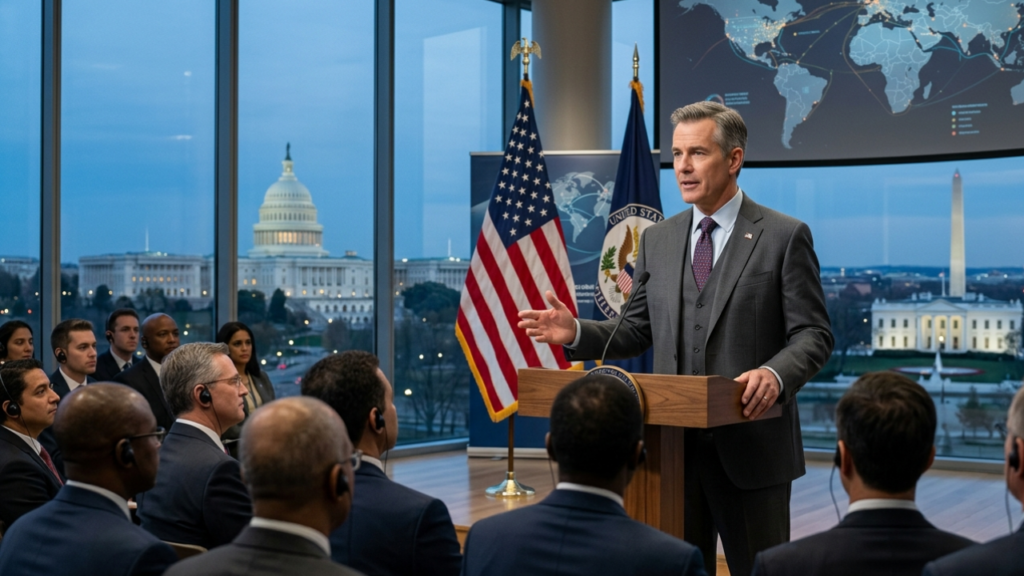
Note: The image is AI generated and for reference
Pingback: US-Iran Tensions Rise After Seizure of Iranian Vessel "Tosca" -