
Author: Hadiya Zainab
Beijing/Taipei, April 29, 2026 (GGPI): Taiwan has become the primary topic of discussions amidst the upcoming talks between US President Donald Trump and Chinese president Xi Jinping, with Beijing pressing Washington to declare its stance against the Taiwanese independence.
Chinese officials have dictated that the upcoming discussions will dominate urging the US to oppose any agreement on Taiwanese independence. This demand signifies that China still views Taiwan as an integral part of China and is pursuing reunification with the mainland.
Wu Xinbo, dean of Fudan University’s Institute of International Studies, who serves on the policy advisory board of China’s foreign ministry have made a statement that reads; “Regarding Taiwan, the logic is simple: if the U.S. does not want to fight a major war with China over Taiwan, it should not support Taiwan independence.”
Read More: US Supreme Court Examines Trump’s Move Against Haitian and Syrian Immigrants
The US, on the other hand, still stands firms on its policy with Taiwan. Its strategic ambiguity still remains, but facilitates Taiwan with self-defense while also abstains from formally endorsing the Taiwanese independence. This position has increasingly come under strains as regional tensions rise.
This has led to concern from Taiwan over the potential outcomes of the summit. Worrying that the possible outcome of the summit may lead to international security and sovereignty issues for Taiwan. Officials are closely eyeing the summit, monitoring developments and wary of any agreements or disagreements that might be met during the summit.
The issue is further complicated by China’s increased military activity and growing pressure near the Taiwanese island, on top of that it limits Taiwanese participation in international forums. At the same time, Beijing offers economic incentives that rather show cooperation and further tightening the ties with Taiwan.
As the summit approaches, Taiwan’s status remains one of the most sensitive and consequential issues in U.S.–China relations, with potential implications for regional stability and global geopolitics.
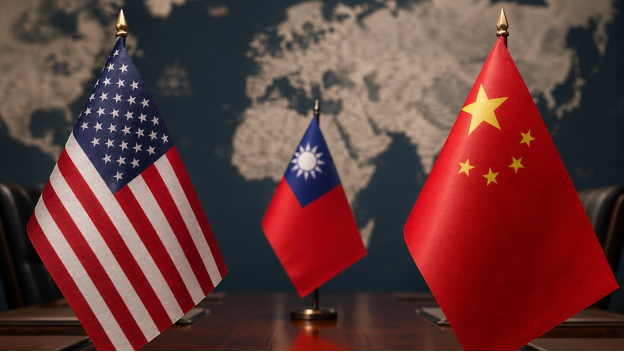
Note: The image is AI generated and only for reference.
About the Author:
Hadiya Zainab is a BS International Relations student at the National University of Modern Languages (NUML), Rawalpindi, and a Research Fellow at Global Geopolitical Insight. Her research interests focus on defence studies, regional security, and contemporary geopolitical dynamics, with a particular emphasis on Asia.