
Author: Hadiya Zainab
Historical Background of the China–Taiwan Divide
The first known settlers of Taiwan were the Austronesian tribal groups that originated from what is now, the Southern China. Taiwan was first mentioned in the Chinese historical records in AD 239, when an emperor sent military expedition towards China. This is also one of the most prominent rhetoric used by China to defend its claim of territorial ownership of Taiwan.
For a short period, Taiwan was ruled by the Dutch, shortly after it came under control of China’s Qing Dynasty. Later, China lost the first Sino-Japanese war, and Taiwan was handed over to Japan, who had to give up several territories as collateral for the World War II, and Taiwan was placed under the Republic of China’s government with approval from The United States and the United Kingdom.
Soon after, a civil war broke out in China. The Communist forces led by Mao Zedong defeated the nationalist forces led by Chiang Kai-shek. Chiang Kai-shek, along with his government and about 1.5 million supporters, fled to Taiwan in 1949. He set up an authoritarian rule and ruled over Taiwan for decades. Only after his death did Taiwan move towards democratic elections and chose their leaders on their own accord in 1996.
A Fragile Status Quo
Speaking of who recognizes and how they recognize Taiwan is a story filled with ambiguity.
Taiwan is an independent region; it has its own constitution, leaders, trade systems, and around 300,000 troops in the military. At first, Chiang Kai-shek’s government in Taiwan (the ROC) claimed it was the true government of all China and planned to take back the mainland. It even held China’s seat at the United Nations Security Council and was recognized by many Western countries as China’s legitimate government. But later, Chiang Kai-Shek, once China’s leader fled to Taiwan and settled there with his supporters.
In 1971, the United Nations officially recognized Beijing instead of Taipei and since then most countries have stopped recognizing Taiwan as a separate country. Today only about 12 countries including Palau, Paraguay and the Vatican City.
The United States’ relationship with Taiwan still remains ambiguous till today’s date. Officially, it does not recognize Taiwan as a separate country but still has strong “unofficial” ties with it. The US’s relationship is guided by laws and agreements such as the Taiwan Relations Act, the U.S.-China joint statements, and the Six Assurances. The U.S. acknowledges China’s position that there is only one China and that Taiwan is part of it, but it also continues close cooperation with Taiwan. Taiwan is an important region for trade especially in the fields of technology and Artificial Intelligence, US is an important democratic partner for Taiwan and both sides work together to improve and strengthen trade through initiatives like US-Taiwan Initiative for 21st Century Trade. At the same time US opposes any violent or unilateral attempts to change the current situation across the Taiwan Strait. All US policies are dictated through the American Institute in Taiwan (AIT).
The government of the People’s Republic of China (PRC) does not accept Taiwan (Republic of China, ROC) as an independent country. Instead, it says Taiwan is part of China and promotes the “One China Principle,” meaning there is only one China, and Taiwan is included in it. Although the PRC does not control Taiwan, it still claims it as part of its territory.
China also makes it a rule, that any country that wants to maintain diplomatic ties with Taiwan must cut all ties with China. Because of this, often times countries have to choose between recognizing Beijing or Taipei. China also uses its global influence to minimize the significance of Taiwan such in international events, such as forcing Taiwan to compete in the Olympics under the name “Chinese Taipei”. China usually refers to Taiwan as “China’s Taiwan Province” and the Taiwanese government as “Taiwan authorities.”
Read More: The United States in a Shifting Global Order: Maintaining Hegemony Amid Rising Multipolarity
Different Taiwanese leaders have taken different positions. Some have described the relationship as special and unclear, while others have emphasized that Taiwan and China are separate on each side of the Taiwan Strait. More recently, Taiwan’s government has avoided strongly claiming control over mainland China and has focused more on Taiwan’s separate identity.
Why the Strategy is under Strain Today?
China-Taiwan relations in 2026 are marked by high tensions and ongoing geopolitical rivalry. China still views Taiwan as part of China, and has not yet ruled out the use of force to achieve reunification to achieve its national goals. China regularly increases military pressure through naval drills, air activity near Taiwan, and political warnings aimed at deterring independence. Taiwan, on the other hand remains sovereign and self-operating resisting any attempt at annexation.
There has been a less ambiguous tone in recent years in U.S. political signals on Taiwan, even as official policy remains unchanged.
U.S. political signaling on Taiwan has become less ambiguous in tone in recent years, although official policy still maintains strategic ambiguity. Traditionally, Washington avoided clearly stating whether it would defend Taiwan militarily, while only affirming opposition to any unilateral change in the status quo. However, recent presidential remarks have been more explicit in wording, even if later softened or clarified by officials.
For example, U.S. President Joe Biden has repeatedly made unusually direct statements when asked about Taiwan. In a 2022 press conference, he said: “Yes… that’s the commitment we made” when asked whether the U.S. would defend Taiwan if it were attacked by China, and later in 2023 he similarly stated: “We would respond” in reference to a Chinese attack scenario. In another instance, he said: “The U.S. does not support Taiwan independence”, reaffirming the official policy line even while using stronger language on defense commitments. In all of these cases, the White House later reiterated that U.S. policy of strategic ambiguity had not changed, and that the United States had not made a formal defense treaty commitment to Taiwan.
This combination—more direct presidential language like “we would defend Taiwan” alongside official clarifications that policy remains unchanged—has led analysts to argue that U.S. signaling is becoming rhetorically clearer and less cautious than in earlier decades, even though the underlying doctrine has not formally shifted.
Regional and Global Implications
China–Taiwan tensions have wide regional and global implications because the dispute is a major flashpoint in East Asia that affects security, trade, and great-power relations. In the region, rising military pressure and the possibility of conflict increase insecurity for nearby states such as Japan, the Philippines, and South Korea, pushing them to strengthen defense cooperation with the United States and prepare for potential instability in the Taiwan Strait. The Taiwan issue also directly shapes U.S.–China relations, as U.S. support for Taiwan and arms cooperation is seen by Beijing as external interference, increasing the risk of broader confrontation between major powers. Economically, the situation has global consequences because Taiwan is deeply integrated into world supply chains, especially in semiconductors, meaning any disruption could affect global technology production, trade flows, and industrial stability.
More broadly, scholars note that the dispute influences the international order by intensifying great-power competition, encouraging regional military alignment, and increasing uncertainty in global geopolitics beyond East Asia.
Conclusion
Strategic ambiguity has long been a force for stability in the China-Taiwan relationship, preventing unilateral Chinese action and any formal declaration of independence by Taiwan. But the factors that have allowed this approach to work are in decline. China’s growing military power and more frequent military activity in the Taiwan Strait, as well as more robust U.S. political statements on Taiwan and its increasing importance to global technology supply chains, have all put new strains on this policy.
This means that ambiguity is increasingly a destabilising factor as much as a stabilising one. The threat is no longer just escalation, but also miscommunication in a context where signals are getting stronger but also more ambiguous. Looking ahead, the sustainability of the status quo will rest on the ability of all sides to continue to work within a framework that is increasingly challenged by changing realities in the Indo-Pacific.
In short, strategic ambiguity may not unravel overnight, but it is becoming increasingly constricted – presenting a crucial question for regional and global security: can this carefully crafted uncertainty still work in a world of escalating geopolitical competition?
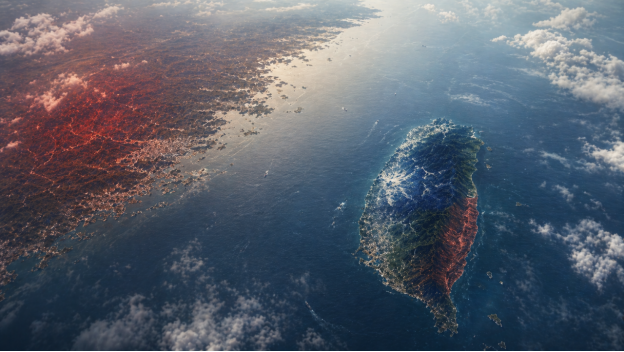
Note: The image is AI generated and for reference
About the Author:
Hadiya Zainab is a BS International Relations Student at the National University of Modern Languages (NUML), Rawalpindi, and a Research Fellow at Global Geopolitical Insight. Her research interests focus on defence studies, regional security, and contemporary geopolitical dynamics, with a particular emphasis on Asia.